Towns in Goa: Panaji, Margao, Vasco, Mapusa, Old Goa and Ponda
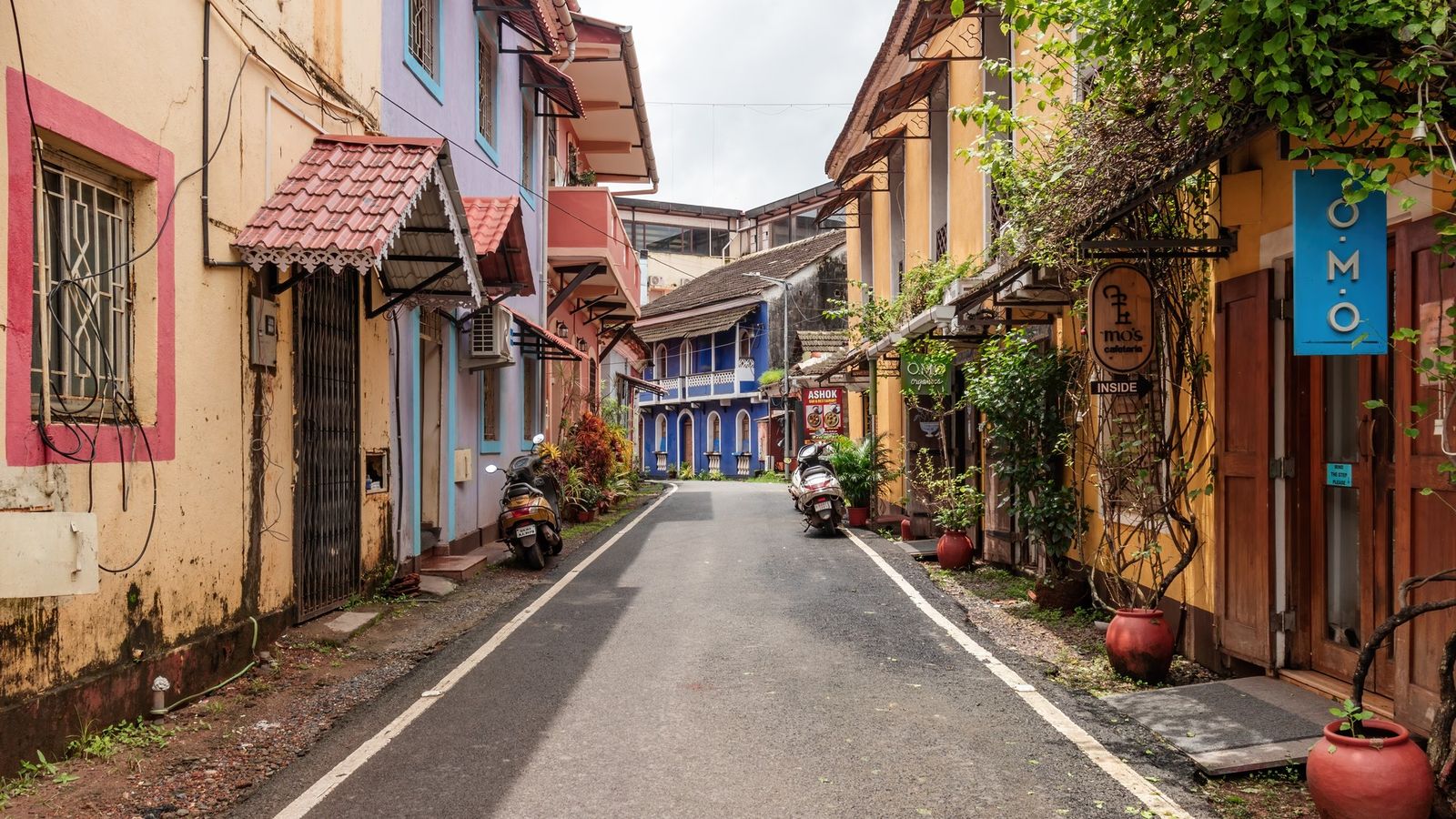
Photo: iMahesh, CC BY-SA 4.0 (cropped), via Wikimedia Commons

The Mandovi waterfront at Panaji on a weekday morning, with the ferries crossing to the north bank.
Goa has no big cities, only small towns, and each is the market, the station or the church square for its stretch of coast and country.
Panaji and Old Goa, on the Mandovi
Panaji, also called Panjim, is the capital and Goa's only municipal corporation, yet it is small: about 115,000 people lived in its urban area at the 2011 Census. It climbs from the river up the Altinho hill, and its old quarter, Fontainhas, is best walked early, before the heat. Miramar beach lies at the river mouth, a short ride from the centre.
Old Goa, about 10 km upriver, was the capital of Portuguese India until disease emptied it. What remains is a quiet field of churches, among them the Basilica of Bom Jesus, a World Heritage Site since 1986. The nearest station for both is Karmali, on the Konkan Railway, 2 km from the churches and about 13 km from Panaji.
Margao and Vasco da Gama, the south
Margao, also written Madgaon, is the headquarters of South Goa and the busiest town in the south, about 33 km from Panaji. Its main station, Madgaon Junction, is where most long-distance trains stop. Around the Church of the Holy Spirit, built in 1675, stand old houses with deep balconies, among them the Sat Burzam Ghor, the "house of seven gables". The covered market is the place to see the town at work. Colva beach, which old lists counted as part of Margao, is a separate village about 6 km away.
Vasco da Gama, usually just Vasco, is a port town on the Mormugao headland, close to Dabolim airport. The port has worked since 1885 and is run by the Mormugao Port Authority, once the Port Trust; its iron-ore berth now stands idle, and a new cruise terminal is unfinished. For a visitor, Vasco is mostly an arrival point, with Bogmalo beach nearby.
Mapusa and Ponda, market and temples
Mapusa, about 13 km north of Panaji, is the market town for the northern beaches. It is quiet most days, but on Friday mornings the weekly market fills the streets with fish, spices, Goan sausages and bananas from nearby Moira. Thivim, about 10 km away, is the nearest station, and Mopa airport is about 25 km north.
Ponda, 28 km south-east of Panaji and 17 km from Margao, is an inland junction and industrial town with little to see in its centre, but the hills around it hold Goa's great temples, rebuilt here after the Portuguese destroyed those nearer the coast. Shri Mangueshi and Shri Mahalsa stand between Priol and Mardol, and the Safa Masjid, a 16th-century mosque beside a walled tank, is about 2 km from the town. See Goa's temples.
Villages, not towns
Calangute, Candolim and Anjuna, which old lists called cities, are beach villages run by village councils. Bicholim is a small mining town, not a beauty spot. Goa now has three districts: Kushavati, formed at the end of 2025 from Quepem, Sanguem, Dharbandora and Canacona, joins North and South Goa. Between towns, Kadamba state buses run often, and the GoaMiles app books taxis at government-set fares.
A day across the towns by bus
Goa's towns lie on one main road and a few river crossings, so they join easily. On its published timetable, Kadamba's bus from Margao to Mopa airport takes about 1 hour 10 minutes from Margao bus stand to Panaji, about 20 minutes more to Mapusa, and about 25 minutes more to Mopa airport. Ponda sits on the inland road between Panaji and Margao, and ordinary buses run all three ways through the day.
A town day might run like this: Margao's market and the Holy Spirit church in the early morning, the temples around Ponda by late morning, Old Goa's churches in the afternoon, and the riverfront at Panaji in the evening. Save Mapusa for a Friday.
Towns to know
- Panaji (North Goa): the capital, 114,759 people in its urban area in 2011 (Census of India); Fontainhas and the river.
- Old Goa (North Goa): the former capital, now a field of World Heritage churches.
- Mapusa (North Goa): the Friday market.
- Ponda (North Goa): the temple hills and the Safa Masjid.
- Margao (South Goa): the Holy Spirit church, the market and Madgaon Junction.
- Vasco da Gama (South Goa): the port and Dabolim airport.
- Quepem (Kushavati): the headquarters of Goa's newest district.
In Goa the town is where the bus turns round, the fish comes in and the church bell keeps the hour.
Plan your visit
| Best season | November to February is dry and pleasant. April and May are hot and humid. From June to September the towns stay open, but heavy rain slows the roads. |
|---|---|
| How to reach | Two airports: Manohar International at Mopa, in the north, and Goa International at Dabolim, near Vasco. Stations: Madgaon Junction for Margao, Karmali for Panaji and Old Goa, Thivim for Mapusa, and Vasco da Gama for the port town. |
| Getting around | Kadamba state buses link every town and both airports. Taxis can be booked through the GoaMiles app at government-set fares. Small ferries cross the rivers near Panaji. |
| Where to stay | Panaji and Fontainhas for the capital and Old Goa; Margao or the villages around it for the south; Mapusa or the nearby beach villages for the north; the countryside around Ponda for the temples. |
| How long to spend | A day for Panaji and Old Goa, half a day each for Margao, Ponda and Mapusa. Vasco needs only a stop on the way to or from Dabolim. More on the state in our Goa guide. |
Questions people ask
Which is the largest town in Goa?
It depends on how you count. At the 2011 Census the Panaji urban area had 114,759 people, Margao's 106,484 and Mormugao's, which includes Vasco, 101,326. Within their municipal limits, Mormugao and Margao were each larger than Panaji.
Is there a ranking of the most developed cities in Goa?
No. There is no official ranking, and Goa's towns are all small.
Are Calangute and Anjuna cities?
No. They are beach villages, each run by a village council, though they are crowded in season. The nearest town for both is Mapusa.
Which railway station is nearest to Panaji?
Karmali, on the Konkan Railway, about 13 km from Panaji and 2 km from the Old Goa churches. Many trains stop only at Madgaon Junction, about 33 km south, so check your train.
Read next
Written by Muthu, editor of Aura of India. Sources: Government of Goa: Margao, Government of Goa: Mapusa, Government of Goa: Ponda, Government of Goa: Safa Masjid, South Goa District: Places of interest, Kushavati District, Government of Goa: About the district, Government of Goa: Kadamba (KTCL) route timings, City Population: Goa towns, Census 2011 figures, The Times of India: Mormugao Port Authority seeks proposals for berth 9 (2026). Last verified: 15 October 2026.
Your turn: Which Goan town did you spend time in rather than pass through, and what kept you there?
Comments
Post a Comment
Comments are always welcome, that will help us to motivate ourselves and improve our services. Thanks!!