Chettinad Mansions of Karaikudi and Kanadukathan: What to See
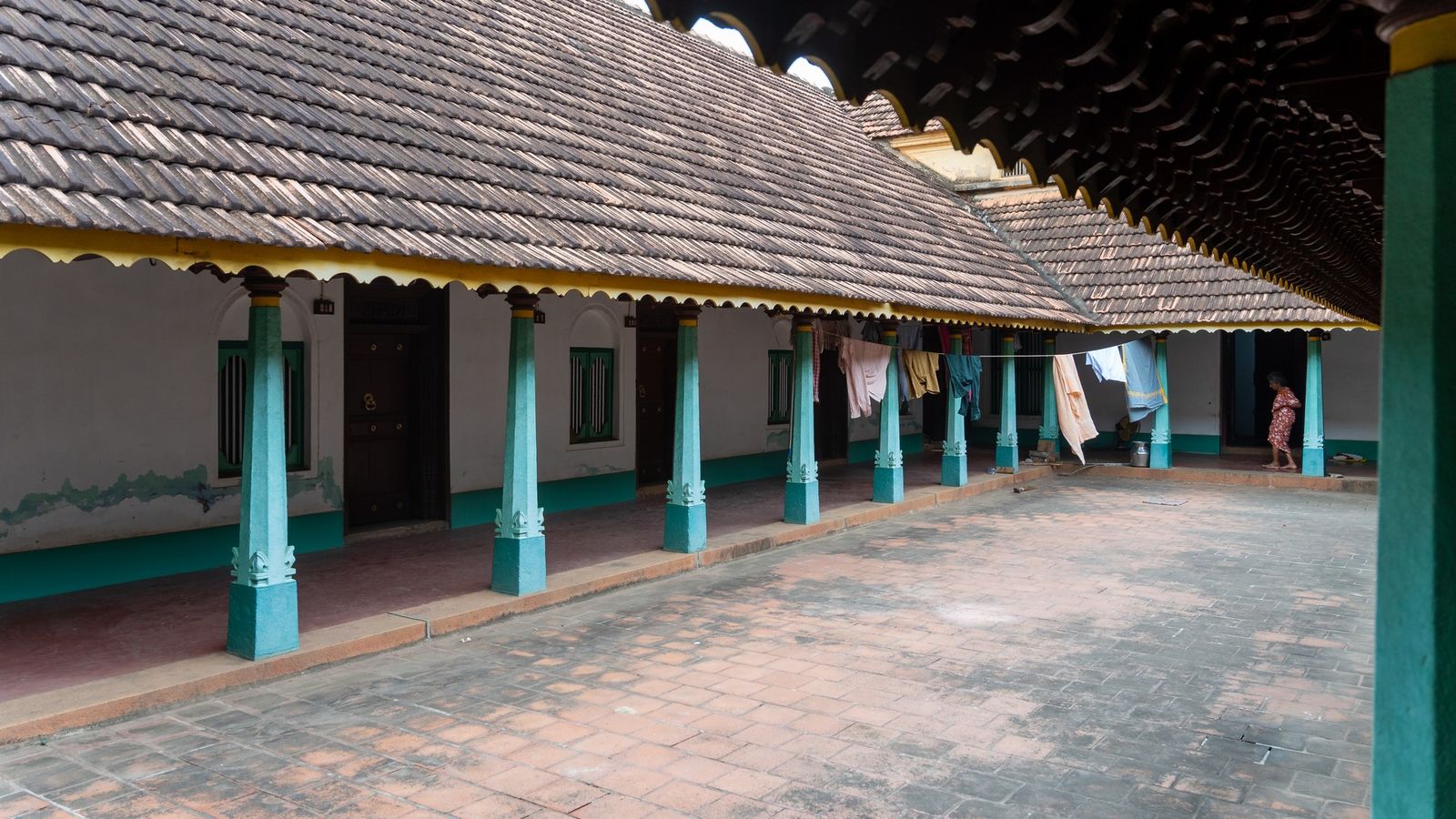
Photo: Rainer Halama, CC BY-SA 4.0 (cropped), via Wikimedia Commons

Kanadukathan and Karaikudi, in the Chettinad country of south Tamil Nadu, on a quiet weekday morning.
The merchants made their money across the Bay of Bengal and spent it at home, one courtyard after another.
Streets of long houses
Chettinad is a dry, flat country of red earth and village tanks: 73 villages and two towns spread over about 1,550 square kilometres of Sivaganga and Pudukkottai districts. The streets run in a grid, and the houses stand shoulder to shoulder along them. From outside, a house shows a raised veranda, a carved door and a long plastered front, sometimes with stucco figures on the parapet.
Behind the door it runs back a long way. Courtyard follows courtyard, each open to the sky and ringed by pillars of Burma teak or granite. Floors are Italian marble or the local Athangudi tiles. Ceilings are painted wood, windows hold coloured glass, and mirrors and chandeliers came from Belgium. The largest houses cover tens of thousands of square feet.
Houses that wait for weddings
These were the family houses of the Nattukottai Chettiars, also called Nagarathars, a community of traders and bankers. The veranda and first hall were where the men met visitors and did business. The inner courtyards held the household, with rooms for married sons and their families, stores, and the kitchen at the back.
Today most owners live in Chennai or abroad, and many houses stay locked for most of the year. Families come back for weddings and rites, and the halls fill again for a few days. A few houses open to visitors, some take guests, and many are slowly falling down. Some have been taken apart and sold, which is why Karaikudi's antique lane is full of carved doors.
Money from across the bay
Records place the Chettiars as salt traders in the seventeenth century. By the nineteenth they were trading and lending across the Bay of Bengal: in Ceylon from 1805, Penang and Singapore from 1824, and Moulmein and Rangoon in Burma by the 1850s. The profits came home as houses, mostly built between the early 1800s and the 1940s. The Depression of the 1930s, the Japanese advance into Burma in 1942 and independence across Southeast Asia ended most of the overseas business.
In 2014 India placed Chettinad on its tentative list for UNESCO World Heritage status, naming 11 villages in three clusters, among them Kanadukathan, Athangudi and Karaikudi. It has not yet been inscribed.
Getting there
Karaikudi is the main town and railway junction, with daily trains to Chennai Egmore; the Pallavan Express takes about six and a half hours. The nearest airports are Madurai and Tiruchirappalli, each about 100 km away by road. Kanadukathan lies a short drive north of Karaikudi, Athangudi to the north-west; hire a car or an auto-rickshaw for the day. Go on a weekday morning, when the light falls straight into the courtyards.
Inside an Athangudi tile
Look down in any Chettinad house and the floor is part of the story. The first owners laid tiles shipped from Europe and Japan. When those cracked, spares were hard to find, so craftsmen in Athangudi began making their own, and the village gave the tile its name.
Each tile is made by hand, face down. A metal frame holding a stencil of the pattern is set on a sheet of glass cut to size. Coloured oxide mixed with cement is poured into each part of the stencil, then covered with dry sand and cement and packed with mortar. The tiles cure in water for days, and when they dry the glass slips away, leaving a smooth, glossy face in red, mustard, green or grey.
Visiting a house that is still a home
Most mansions belong to large families, often shared among many heirs, and none is a government monument. Hours, tickets and access are set by the owners, and houses close for family functions. Keep to the open rooms and do not touch the woodwork or the glass.
Give the area two days: one for Kanadukathan and Athangudi, one for Karaikudi and the quieter streets of Pallathur and Kothamangalam. Many travellers fly into Madurai and add the Meenakshi temple; for the rest of the state, see the Tamil Nadu guide.
Places to know
- Chettinad Palace, Kanadukathan: the Raja's house, built in 1912; privately owned, so entry is at the family's discretion.
- Athangudi Palace: a restored mansion open daily to ticketed visitors.
- Athangudi tile workshops: handmade cement tiles, poured on glass in the village that gave them their name.
- Karaikudi antique lane: behind the Muneeswaran temple; doors, pillars, lamps and brass from dismantled houses.
- Kandangi weavers: Karaikudi's cotton sarees with very wide contrast borders, a registered GI since 2019.
- Pallathur and Kothamangalam: quieter mansion streets in the same tentative-list cluster as Kanadukathan.
The door is shut, the street is empty, and the courtyard behind it is still waiting for a wedding.
Plan your visit
| Entry fee | Athangudi Palace: ₹80 for adults, ₹120 for foreign visitors, ₹120 for a camera; children under 10 free (as of October 2026, including GST). Other houses: check at the gate. |
|---|---|
| Opening hours | Athangudi Palace: 9.30 am to 5 pm daily, last entry 4.30 pm; it may close for festivals and family events. Chettinad Palace, Kanadukathan: private, check before you go. |
| Best time | October to March. Northeast monsoon showers fall from late October into December; April to June is very hot. |
| How to reach | By train to Karaikudi Junction, for example the Pallavan Express from Chennai Egmore, then by car or auto-rickshaw to the villages. |
| Nearest airport and station | Madurai and Tiruchirappalli airports, each about 100 km by road; Karaikudi Junction station. |
| Where to stay | Karaikudi for trains and food; Kanadukathan, Pallathur or Kothamangalam for the mansion streets, where some houses take guests. |
| Dress and rules | These are homes. Shoes off where asked, no touching, and ask before photographing people. |
Open Kanadukathan, Sivaganga district, Tamil Nadu in Google Maps
Questions people ask
Can you go inside the Chettinad mansions?
Some of them. Athangudi Palace is open daily with a ticket, and a few others let visitors in when a caretaker is there. Most houses are private homes and stay locked.
Is Chettinad a UNESCO World Heritage Site?
Not yet. India added 'Chettinad, Village Clusters of the Tamil Merchants' to its tentative list in 2014, covering 11 villages in Sivaganga and Pudukkottai districts.
Is Karaikudi or Kanadukathan the better base?
Karaikudi has the station, more rooms and more food. Kanadukathan is quieter and puts you on a mansion street, where some houses take guests.
Can I visit the Chettinad Palace at Kanadukathan?
It is a private family home with no published hours or ticket. The family sometimes admits visitors to the front halls; check locally before you make the trip.
Read next
Written by Muthu, editor of Aura of India. Sources: UNESCO World Heritage Centre: Chettinad, Village Clusters of the Tamil Merchants (tentative list), Athangudi Palace: plan your visit (hours and tickets), Karaikudi City Municipal Corporation: how to reach, Frontline: Chettinad's legacy, Geographical Indications Registry: Kandangi Sarees, The Hindu: From Athangudi, with love (how Athangudi tiles are made), BBC Travel: India's 10,000 forgotten mansions. Last verified: 15 October 2026.
Your turn: Which Chettinad house have you walked through, and what stayed with you: the tiles, the woodwork or the size of the courtyards?
Comments
Post a Comment
Comments are always welcome, that will help us to motivate ourselves and improve our services. Thanks!!