Karnataka Temples: Hampi, Belur, Badami and How to Visit Them
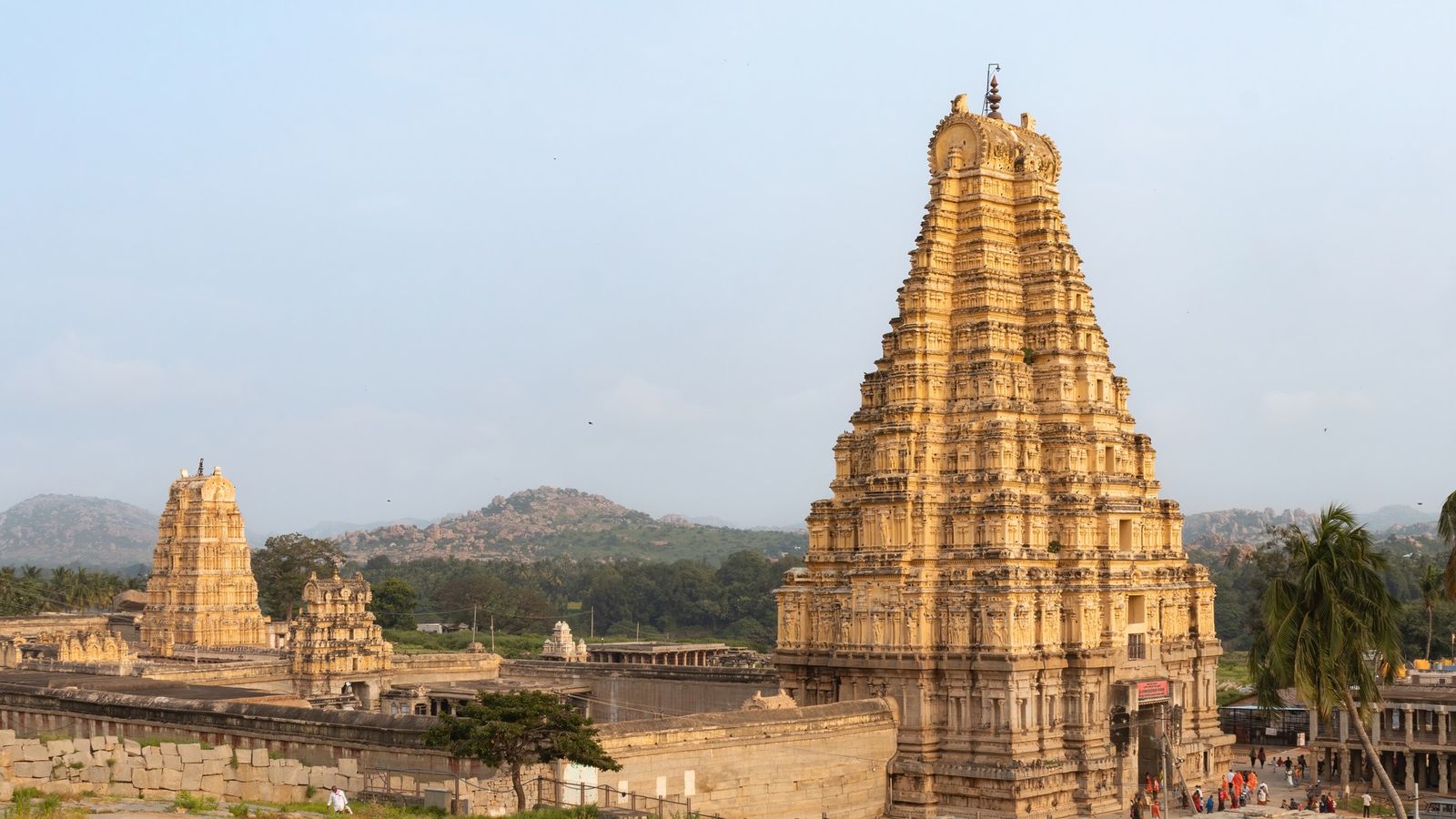
Photo: iMahesh, CC BY-SA 4.0 (cropped), via Wikimedia Commons

Karnataka, from the boulders of Hampi to the Hoysala carvings of Belur.
In Karnataka, a thousand years of temple building are laid out within a day's drive of each other.
A temple still in use at Hampi
Among the ruins of Hampi, once the capital of the Vijayanagara empire, one temple never stopped working. The Virupaksha temple, with its tall white gateway tower, stands at the end of the old bazaar street, and worship continues inside as it has for centuries. The rest of Hampi is a landscape of boulders, stone halls and temple ruins on the Tungabhadra river, a UNESCO World Heritage Site.
Carved stone and cave halls
In the north, at Badami, sixth-century cave temples are cut into red sandstone cliffs above a lake. Nearby Aihole and Pattadakal hold some of the earliest stone temples in India. In the south-west, at Belur and Halebidu, the Hoysala kings of the twelfth century built temples of soft soapstone, carved so finely that the figures seem to wear lace. The Chennakeshava temple at Belur is still in worship. In 2023 the Hoysala temples joined the UNESCO list.
Why people come
Pilgrims travel to Kukke Subramanya in the forests of the Western Ghats, to the Mookambika temple at Kollur, and to Gokarna, a small coastal town where the Mahabaleshwar temple is linked to a legend of Ravana and Shiva. At Murudeshwar, a giant statue of Shiva stands on a headland over the Arabian Sea. In Mysuru, the Chamundeshwari temple sits on Chamundi Hill above the city, and the goddess is at the centre of the city's Dasara festival each autumn, in late September or October.
Getting there
Bengaluru has the main international airport. Hampi is reached from the town of Hosapete, which has trains, and from the small airport at Vidyanagar. Belur and Halebidu are about four hours from Bengaluru, via Hassan. Gokarna, Murudeshwar and Kollur lie along the coast north of Mangaluru, which has an airport and the Konkan railway.
Belur and Halebidu, the Hoysala pair
The Hoysala king Vishnuvardhana built the Chennakeshava temple at Belur to mark his victory over the Cholas in 1116, and worship has continued there since it was consecrated in 1117. Its walls stand on a star-shaped platform, and its carvers, among them a father and son named Dasoja and Chavana, signed their work. Look up at the bracket figures under the eaves: dancers and musicians, each with her own jewellery.
Halebidu, the old Hoysala capital, is twenty-three kilometres away. Its Hoysaleswara temple is no longer in full worship, and its walls carry some of the most crowded friezes in India: elephants, horsemen and scenes from the epics, rank above rank. With the Keshava temple at Somanathapura near Mysuru, the two became a UNESCO World Heritage Site, the Sacred Ensembles of the Hoysalas, on 18 September 2023.
A northern loop: Badami, Aihole and Pattadakal
In the north, three sites of the Chalukya kings lie within a short drive of each other. Badami has four cave temples cut into its red sandstone cliff above the Agastya lake. Aihole, with over a hundred temples, was where the early builders experimented with form. Pattadakal, a UNESCO World Heritage Site, is where they brought the southern and northern styles together side by side.
Stay two nights in Badami and see all three, then go on to Hampi, about four hours to the south-east. For the rest of the state, see the Karnataka guide.
Temples to know
- Virupaksha, Hampi: the living temple among the ruins.
- Chennakeshava, Belur: Hoysala carving at its finest.
- Badami cave temples, Bagalkot district: halls cut into a red cliff.
- Chamundeshwari, Mysuru: the goddess on the hill above the city.
- Kukke Subramanya, Dakshina Kannada: a forest shrine of the serpent god.
- Mookambika, Kollur: a goddess temple at the foot of the Ghats.
- Mahabaleshwar, Gokarna: an old Shiva temple by the sea.
- Murudeshwar, Uttara Kannada: a giant Shiva on a headland.
- Ranganathaswamy, Srirangapatna: Vishnu on an island in the Kaveri.
At Belur, bring a torch. The best carving is in the shade of the brackets under the roof.
Plan your visit
| Entry fee | Working temples are free to enter. ASI-ticketed sites charge a fee: at Hampi, ₹40 for Indian and ₹600 for foreign visitors (as of October 2026). For Badami, Aihole and Pattadakal, check at the gate. |
|---|---|
| Opening hours | Chennakeshava, Belur: 7.30 am to 7.30 pm daily (Karnataka Tourism). Hampi's ticketed monuments: 6 am to 6 pm. Working temples close for some hours in the afternoon: check before you go. |
| Best time | October to February. Mysuru Dasara runs from 11 to 21 October 2026, with the Jamboo Savari elephant procession on 21 October. |
| How to reach | Bengaluru has the main international airport. Hassan, 38 km from Belur, has trains and buses. Hosapete is the station for Hampi; Badami has its own station. Mangaluru has an airport and the Konkan railway for the coast. |
| Where to stay | Hosapete or Kamalapura for Hampi; Hassan or Belur for the Hoysala temples; Badami town for the Chalukya sites; Mysuru for Chamundi Hill and Srirangapatna. |
| Dress and rules | Cover shoulders and knees, and leave shoes at the gate. Some coastal temples ask men to remove their shirts before entering the inner shrine. Photography rules vary by temple. |
Questions people ask
How far is Halebidu from Belur?
About 23 kilometres. Most visitors see both in one day from Hassan, which is 38 kilometres from Belur.
When is Mysuru Dasara in 2026?
From 11 to 21 October 2026, ending with the Jamboo Savari on Vijayadashami, 21 October. Mysuru follows the palace calendar, which can put Vijayadashami a day after the date in national calendars.
Are the Hoysala temples a UNESCO World Heritage Site?
Yes. Belur, Halebidu and Somanathapura were inscribed together as the Sacred Ensembles of the Hoysalas on 18 September 2023, India's 42nd World Heritage Site.
How many days do I need for Karnataka's temples?
About a week: two days for Hampi, two for Badami, Aihole and Pattadakal, and a day each for Belur with Halebidu and for Mysuru.
Read next
Written by Muthu, editor of Aura of India. Sources: UNESCO World Heritage Centre: Sacred Ensembles of the Hoysalas, Karnataka Tourism: Chennakeshava Temple, Belur, Hassan District, Government of Karnataka: Chennakeshava Temple, Belur. Last verified: 13 October 2026.
Your turn: Which carving at Belur or Halebidu held you longest, and did you take a torch?
Comments
Post a Comment
Comments are always welcome, that will help us to motivate ourselves and improve our services. Thanks!!