Coorg (Kodagu): Coffee Estates, Best Time and How to Get There
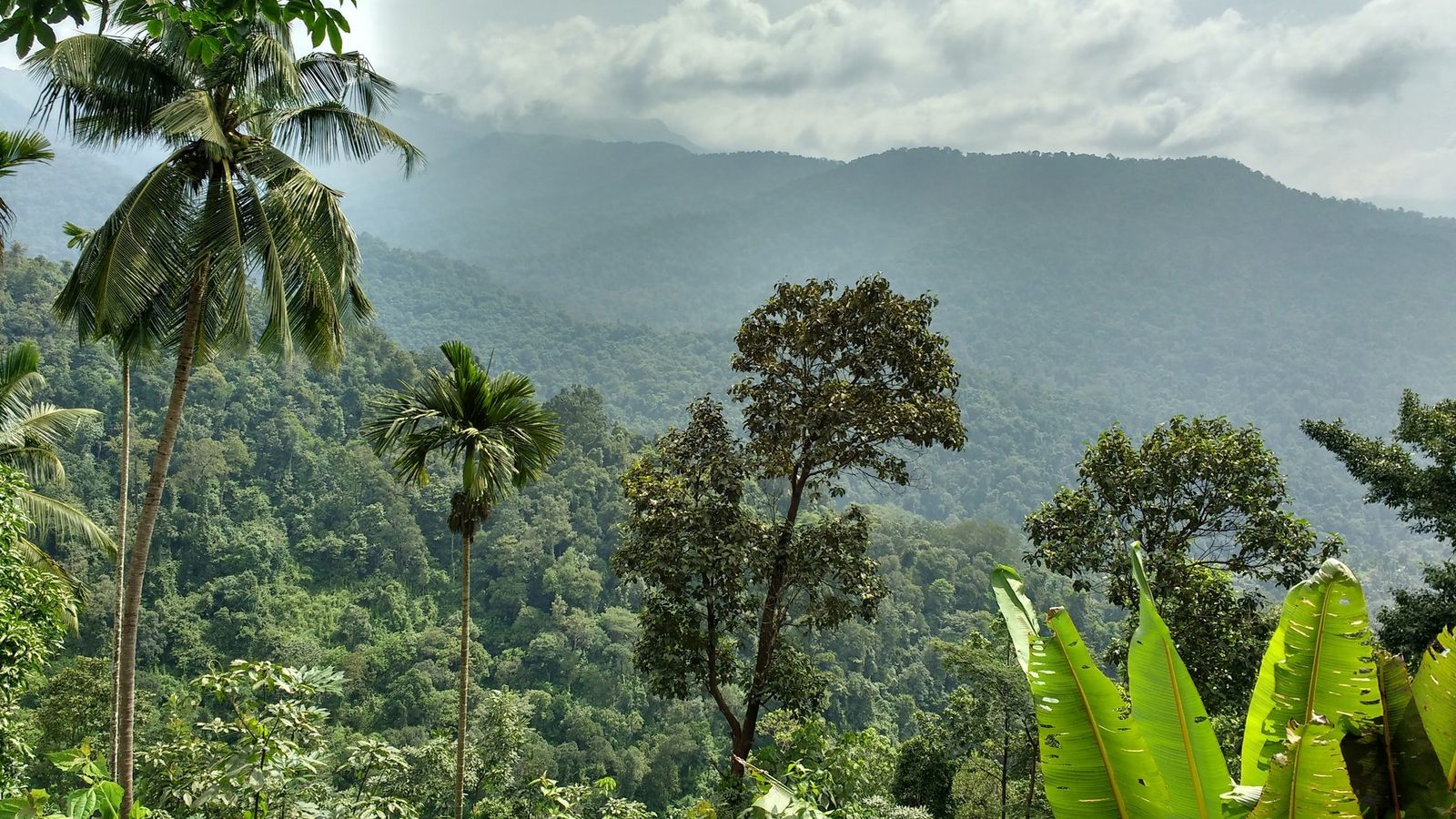
Photo: Charan Kumar, CC BY-SA 4.0 (cropped), via Wikimedia Commons

Kodagu (Coorg), in the Western Ghats, on a late-October morning as the monsoon ends.
In Coorg the forest was not cleared for coffee; the coffee was planted underneath it.
Coffee in the half-light
Kodagu, which most visitors still call Coorg, is a district of steep green hills on the eastern slope of the Western Ghats. Its main town, Madikeri, lies about 250 km west of Bengaluru. Much of the land between the towns is coffee, but not in open rows. It grows under two layers of shade: tall forest trees above, smaller trees below, and the low coffee bushes in the half-light between them. Pepper vines climb the trunks. In late October the slopes are dark and wet, and the coffee berries hang green on the branch, a few weeks short of turning red.
Living by the crop
Coffee here is mostly a small grower's crop. The district's own figures say most coffee land is held in plots of under ten hectares, and that about half of all jobs in Kodagu are on the plantations. Robusta, the hardier bean, fills the warmer ground around Madikeri and Virajpet. Arabica, which needs height and cool air, is the main crop around Somwarpet in the north. Arabica picking starts in November, Robusta in December. Between the bushes, estates grow pepper, cardamom, areca nut and the small Coorg orange, which has its own Geographical Indication, a legal tag tied to the place.
Why people come
Most come for the cool air and the green. Kodagu receives around three metres of rain a year, most of it between mid-June and September. But the district is also the home of the Kodavas, a community with its own language, dress and festivals, tied to the rice fields on the valley floors. Each clan keeps an ainmane, an ancestral house of mud, timber and stone, where the family gathers for festivals. High on Brahmagiri hill, at Talacauvery, the river Kaveri rises from a small spring. On Kaveri Sankramana, which fell on 17 October this year, pilgrims gathered there in the evening to watch the water well up at the appointed hour.
Getting there and around
No railway line runs into Kodagu. The nearest stations are Hassan, about 105 km from Madikeri, and Mysuru, about 120 km. Kannur International Airport, across the border in Kerala, is about 90 km away, and Mangaluru about 140 km. State buses run to Madikeri from Bengaluru, Mysuru and Mangaluru. Inside the district, hire a car with a driver in Madikeri; the roads are narrow, steep and slow.
The Kodava year
Kodagu's own calendar follows the rice in the valleys, not the coffee on the slopes. Kailpodh, in September, marks the end of transplanting: tools and guns are worshipped, and villages meet on the mand, the village green, for games. Kaveri Sankramana, in October, honours the river at its source. Puthari, the harvest, comes in November or December. On a full-moon night the head of the family cuts the first sheaf of new rice while the household calls out "Poli, poli, deva", asking for plenty.
These festivals are kept at the ainmane. Many stand quiet for most of the year and fill up only for festivals and family ceremonies. They are private homes; see one only if you are invited.
Two slow days
Day one, Madikeri and an estate. Many estates run homestays; spend the morning on the estate paths with the owner, among the shade trees, pepper vines and coffee bushes. In the afternoon walk down through the plantation to Abbey Falls and its hanging bridge. End at Raja's Seat in Madikeri, where people gather to watch the sun go down.
Day two, the river or the plateau. Go west to Bhagamandala and climb on to Talacauvery on Brahmagiri hill. Or go east to Kushalnagar for the elephant camp at Dubare and the Tibetan settlements at Bylakuppe. From Kushalnagar the main road continues to Mysuru and the railway.
Places to know
- Madikeri: the district town, once called Mercara; Raja's Seat, a garden on the edge of a ridge, faces the western hills.
- Abbey Falls: about 6 km from Madikeri, reached on foot through private coffee land; no bathing.
- Talacauvery and Bhagamandala: the source of the Kaveri on Brahmagiri hill, and the temple town where streams meet below it.
- Mandalpatti: open grassland above the forest; the last stretch is by local four-wheel-drive jeep.
- Dubare: an elephant camp on the Kaveri near Kushalnagar.
- Bylakuppe: Tibetan settlements near Kushalnagar, with the large Namdroling monastery.
By mid-morning the mist has left the valley, and the only sound on the estate path is water dripping from the shade trees.
Plan your visit
| Entry fee | None for the district. Abbey Falls, Raja's Seat, Mandalpatti and Dubare charge small fees; check at the gate (as of October 2026). |
|---|---|
| Opening hours | Abbey Falls: 9 am to 5 pm. Other sights keep their own hours; check before you go. |
| Best time | October to March, after the rain. The monsoon runs from mid-June to September. |
| How to reach | State buses to Madikeri from Bengaluru (about 250 km), Mysuru and Mangaluru. Mandalpatti's last stretch is by local jeep only. |
| Nearest airport and station | Kannur International Airport, Kerala (about 90 km) or Mangaluru (about 140 km). Stations: Hassan (about 105 km), Mysuru (about 120 km). |
| Where to stay | Estate homestays registered with the Karnataka Tourism Department; Madikeri town for buses and shops; Somwarpet for the cooler north; Virajpet and Gonikoppal for the south. |
Questions people ask
Is late October a good time to visit Coorg?
Yes. The monsoon is ending, the estates are at their greenest and the waterfalls are still full. Expect an occasional shower and mist on the hills in the early morning.
Can you walk through a coffee estate in Coorg?
Only with permission, because the estates are private land. Many run homestays, and a walk with the owner is often part of the stay. The path to Abbey Falls also crosses private coffee land.
Are Coorg and Kodagu the same place?
Yes. Kodagu is the official name of the district; Coorg is the older English form and is still widely used. Madikeri, the district town, was once called Mercara.
Is there a railway station in Coorg?
No railway line runs into Kodagu. Take a train to Hassan or Mysuru and continue by bus or taxi to Madikeri.
How many days do you need in Coorg?
Two days are enough for one estate, Madikeri and one side trip. Allow three or four to see both Talacauvery and the Kushalnagar side without hurrying.
Read next
Written by Muthu, editor of Aura of India. Sources: Kodagu District, Government of Karnataka: Tourism, Kodagu District, Government of Karnataka: Coffee Board (coffee area, holdings, employment), Kodagu District, Government of Karnataka: Fairs and festivals, Coffee Board of India: Coffee regions (shade canopy, intercrops), Coffee Board of India: Production statistics 2025-26, Karnataka Tourism: Abbey Falls, Karnataka Tourism: Coorg (Kodagu), Intellectual Property India: State-wise registered GIs (Coorg Orange), The Kodagu Express: Cauvery Theerthodbhava at Talacauvery on 17 October 2026. Last verified: 15 October 2026.
Your turn: Have you stayed on a Coorg coffee estate? Which part of Kodagu, the Arabica north or the Robusta south, would you go back to?
Comments
Post a Comment
Comments are always welcome, that will help us to motivate ourselves and improve our services. Thanks!!