Maharashtra Travel: Mumbai, Ajanta, Ellora and the Maratha Forts
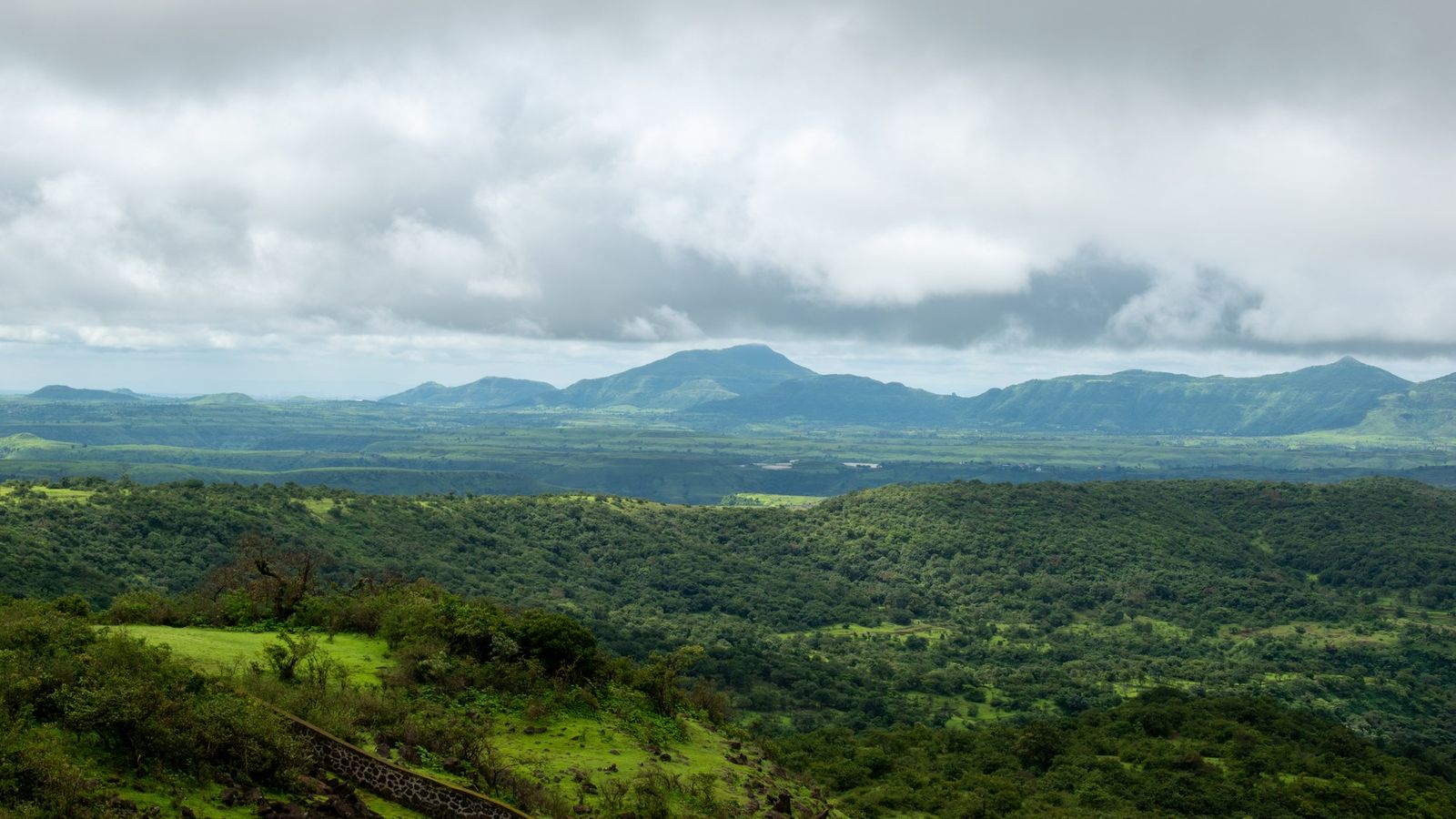
Photo: Rohit Sharma, CC BY-SA 4.0 (cropped), via Wikimedia Commons

Maharashtra in late October, from the Mumbai shore up to the Sahyadri hills.
Maharashtra only makes sense once you have changed height.
A coast, a wall and a plateau
Maharashtra lies on India’s west coast, between Gujarat and Goa. Along the sea runs the Konkan, about 720 kilometres of beaches, creeks, palms and old sea forts. Behind it rises the Sahyadri, the local name for the Western Ghats, a steep wall of dark basalt hills. Climb it and you reach the Deccan plateau, drier and wider, where most of the state lives. Mumbai, the capital, sits on what were once islands.
How the state lives
Mumbai is India’s money city and the home of its film industry. Pune, a few hours inland, is a city of colleges and the old seat of the Peshwas, the ministers who ran the Maratha empire in the eighteenth century. The language is Marathi. The food changes with the land: in Mumbai, vada pav, a bun wrapped round a fried, spiced potato ball; fish curry soured with kokum, a purple fruit, on the coast; fiery misal, a curry of sprouted beans, on the plateau.
Why people come
For many, the reason is rock. Near Chhatrapati Sambhajinagar, the city once called Aurangabad, are two of India’s great cave sites, both on UNESCO’s World Heritage list since 1983. At Ajanta, Buddhist monks cut thirty caves into a horseshoe-shaped cliff, and some walls still carry paintings about fifteen hundred years old. At Ellora, Buddhist, Hindu and Jain caves stand side by side, and the Kailasa temple was carved downwards out of the hill. Then there are the Maratha forts, high on the Sahyadri and out at sea. Twelve of them joined the World Heritage list in 2025.
How to get around
Mumbai, Pune and Chhatrapati Sambhajinagar all have airports. Trains climb the ghats to Pune in a little over three hours, and the fastest reach Chhatrapati Sambhajinagar in about six. The Konkan Railway runs south along the coast towards Goa. For caves and forts, hire a car and driver. Ajanta and Ellora are about a hundred kilometres apart, so give them a day each.
Ajanta and Ellora, up close
Ajanta was cut in two phases, about four centuries apart. The first caves date from the second and first centuries BCE, simple halls where the Buddha is shown only by symbols. The second phase, in the fifth and sixth centuries CE, added richly carved monasteries and the murals the site is known for, painted in tempera on a layer of clay and lime. Five of the thirty caves are chaityagrihas, prayer halls with a stupa at the far end; the rest are viharas, monasteries with cells for monks.
Ellora is later, from about the sixth to the twelfth century. Its caves run for nearly two kilometres along a hillside: Caves 1 to 12 are Buddhist, 13 to 29 Hindu and 30 to 34 Jain. The Kailasa, Cave 16, is attributed to the Rashtrakuta king Krishna I in the eighth century, and the Archaeological Survey of India calls it the largest single monolithic excavation in the world. With three or four hours, the ASI suggests Caves 10, 16, 21, 32 and 34. Unlike Ajanta, which was forgotten for centuries, Ellora was never lost; it stood beside an old trade route. The Grishneshwar temple, close by, is covered in Maharashtra’s temples.
A week across the state
Start with two days in Mumbai: the Fort area and the Chhatrapati Shivaji Maharaj Terminus, the Gateway of India, and a ferry from the Gateway to the Elephanta Caves, which are closed on Mondays. Then fly or take the train to Chhatrapati Sambhajinagar.
Plan the caves around their closing days. Ajanta is closed on Mondays and Ellora on Tuesdays, so Ellora on a Monday and Ajanta on a Tuesday works well. Add the Bibi ka Maqbara and Daulatabad fort on the Ellora day if you start early.
Finish in Pune, with a morning on one of the hill forts, or go down to the Konkan for two quiet days by the sea. Shivneri, where Chhatrapati Shivaji Maharaj was born, and Raigad, where he was crowned in 1674, are both part of the 2025 World Heritage listing. For more on the state, see our Maharashtra guide.
Places to know
- Mumbai: the Gateway of India, the Gothic Fort district and Marine Drive.
- Ajanta: painted Buddhist caves above a river gorge. Closed on Mondays.
- Ellora: thirty-four caves of three faiths, and the Kailasa. Closed on Tuesdays.
- Chhatrapati Sambhajinagar: the base for both, with the Bibi ka Maqbara.
- Pune: the Peshwas’ Shaniwar Wada, with hill forts within reach.
- The Konkan: Alibaug, Ganpatipule, Malvan and the sea fort of Sindhudurg.
Take one ghat road in daylight. Near the top, the damp sea air turns dry, and you are in another Maharashtra.
Plan your visit
| When to go | Late October gives you the ghats still green from the rain with the fort paths drying out. Through to March the cave country stays dry and mild; skip the monsoon months for forts, and April and May for the heat around Ajanta and Ellora. |
|---|---|
| The route | Mumbai, then up to Chhatrapati Sambhajinagar by air or by train (the fastest take about six hours), then across to Pune for the hill forts. Mumbai trains leave from CSMT, Dadar and Lokmanya Tilak Terminus. |
| Reaching the caves | Hire a car and driver in Chhatrapati Sambhajinagar. Ellora is about 31 km away by road, Ajanta about 103 km, so give each its own day. |
| Cave tickets and days | Ajanta opens 9 am to 5 pm and shuts on Mondays; Ellora opens sunrise to sunset and shuts on Tuesdays. Indians and visitors from SAARC and BIMSTEC countries pay ₹35 a site if booked online, ₹40 at the counter; other foreign visitors pay ₹550 online, ₹600 at the counter. Under-15s go in free. Checked October 2026. |
| Where to stay | Near CSMT or the Gateway in Mumbai, for the Fort walks and the Elephanta ferry; two nights in Chhatrapati Sambhajinagar, between the two cave sites; Pune as the base for a fort morning in the Sahyadri. |
| How long to spend | Six or seven days for Mumbai, the two cave sites and Pune. The sea forts, such as Sindhudurg off Malvan, need extra days on the Konkan; the Maharashtra guide covers the coast. |
Open Ellora Caves, Chhatrapati Sambhajinagar, Maharashtra in Google Maps
Questions people ask
In what order should I see Ajanta and Ellora?
Let the closing days decide. Ajanta shuts on Mondays and Ellora on Tuesdays, so a Monday at Ellora followed by a Tuesday at Ajanta keeps both open. Ajanta runs 9 am to 5 pm; Ellora is open from sunrise to sunset.
Is it cheaper to book Ajanta and Ellora tickets online?
Slightly. For Indians and SAARC or BIMSTEC nationals, an online ticket is ₹35 against ₹40 at the counter; for other foreign visitors it is ₹550 against ₹600. Under-15s need no ticket. Checked October 2026.
Can I see Ajanta and Ellora in one day?
It is possible but rushed. The two sites are about 100 km apart, and each deserves most of a day. Two days from Chhatrapati Sambhajinagar is better.
What are the Maratha Military Landscapes?
A World Heritage Site listed by UNESCO in 2025: twelve forts built, adapted or expanded by the Marathas, eleven in Maharashtra and one, Gingee, in Tamil Nadu. They include Raigad, Shivneri, Pratapgad, Lohagad and the sea fort of Sindhudurg.
When is the best time for the Maratha forts?
From late October, once the rain has stopped and the paths up Raigad, Shivneri and the other Sahyadri forts have dried, until about March. In the monsoon, June to September, the hills are green but the climbs turn slippery.
Read next
Written by Muthu, editor of Aura of India. Sources: Archaeological Survey of India: Ajanta Caves (hours and fees), Archaeological Survey of India: Ellora Caves (hours and fees), UNESCO World Heritage Centre: Ajanta Caves, UNESCO World Heritage Centre: Maratha Military Landscapes of India, Maharashtra Tourism: Ajanta (distances and access), Maharashtra Tourism: Coastal Tourism (720 km coastline). Last verified: 14 October 2026.
Your turn: If you had one free day near Chhatrapati Sambhajinagar, would you give it to Ajanta’s paintings or Ellora’s Kailasa, and why?
Comments
Post a Comment
Comments are always welcome, that will help us to motivate ourselves and improve our services. Thanks!!