Fatehpur Sikri: Buland Darwaza, Tickets and Day Trip
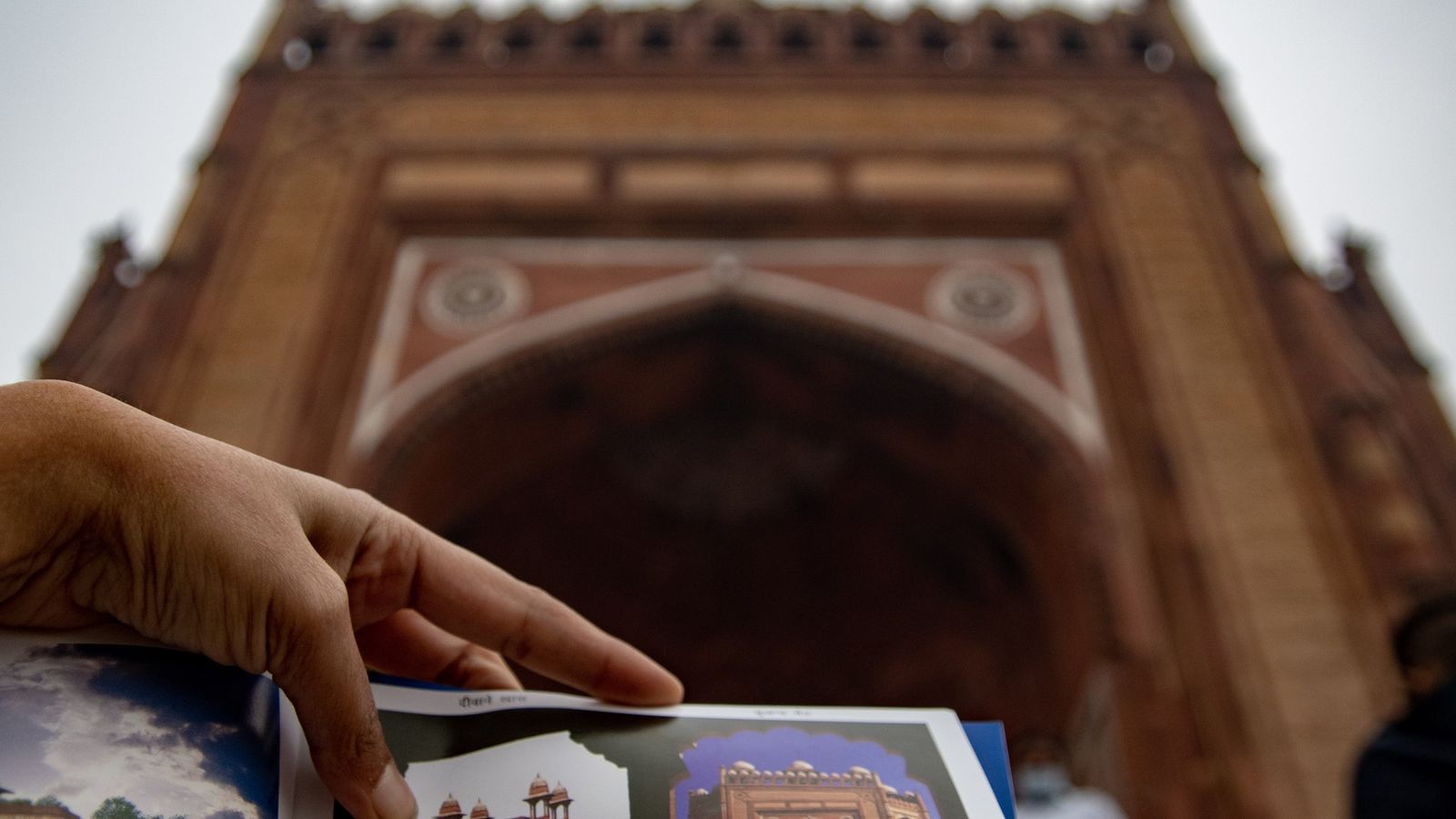
Photo: Darshanavenugopal, CC BY-SA 4.0 (cropped), via Wikimedia Commons

Fatehpur Sikri, west of Agra, in the dry light of a winter afternoon.
The capital did not last. The red sandstone city still does.
A gateway that fills the sky
From the ridge the first mass is Buland Darwaza, the Victory Gate. Agra district records it at about 54 metres. Red sandstone steps climb toward a high arch; above it, the sky looks cut square. Behind the gate lies the Jama Masjid courtyard, pale marble of Sheikh Salim Chishti’s tomb catching the sun, and the palace terraces stepping down the hill. In the afternoon the stone holds heat and the courtyards empty of the morning rush. The haze softens the far plain toward Agra.
How a day moves through the city
Most visitors come from Agra for half a day. Battery carts and short walks take them from the parking base up to the Diwan-i-Am ticket side. Guides point out the Panch Mahal’s stacked floors, the Diwan-i-Khas column, Anup Talao and the women’s palace courts. Shoes come off for the mosque and the dargah; elsewhere they stay on. The site is open sunrise to sunset. By mid-afternoon the light is low enough for photographs without the noon glare, and the ridge breeze starts to cool the stone.
Why the ridge was chosen
Akbar moved court here in the 1570s to honour the Sufi saint Sheikh Salim Chishti, who lived on this ridge. For about fourteen years Fatehpur Sikri was the Mughal capital: planned terraces, water systems, workshops and a mosque complex that still reads as a full city. Then the court returned to Agra. Water, politics and habit all played a part; the buildings stayed. UNESCO lists the ensemble as a World Heritage Site. What remains is not a ruin of one palace but a whole abandoned capital in red stone.
Getting there from Agra
Fatehpur Sikri sits about 36 to 40 km west of Agra on the Fatehpur Sikri Road. UPSRTC buses leave from Idgah and ISBT; taxis and hired cars make the round trip easy in a morning or afternoon. Private cars park below; authorised battery buses run up to the monument gate. Plan three hours on site if you want both the palace courts and the Buland Darwaza approach. Pair the day with Agra Fort or the riverfront rather than rushing a second ticket queue at the Taj. For the wider state, see the Uttar Pradesh guide.
Palace courts after the gate
After Buland Darwaza and the mosque courtyard, most visitors walk the secular terraces: Diwan-i-Am, the Panch Mahal’s five diminishing floors, Diwan-i-Khas, Anup Talao and the residential courts. The Archaeological Survey of India describes Fatehpur Sikri as the first planned Mughal city, with terraces linked across the ridge and an early drainage system still readable in the stone.
Keep half your time for these courts if the gate photograph was the lure. The afternoon haze softens distant Agra; close stone detail stays sharp. The site museum near the Diwan-i-Am booking counter is free and open 9 am to 5 pm, closed on Fridays.
A simple Agra day plan
Leave Agra after an early fort or riverfront hour, reach Fatehpur Sikri by late morning or early afternoon, and return before dark. Buses and taxis both work; a hired car simplifies the parking-to-gate transfer. Do not try to stack the Taj’s busiest ticket slot on the same breathless afternoon.
Foreign visitors who already hold the same-day ADA pathkar from the Taj need not buy that toll again here; Fridays the ADA toll is not charged. For the city around the monuments, see the Agra story in the schedule and the Uttar Pradesh guide.
What to keep in mind
- Buland Darwaza: climb the steps slowly; the height is the point of the approach.
- Mosque and dargah: cover shoulders and head as asked; leave shoes at the racks.
- Guides: use licensed guides near the ticket counters; ignore unlicensed pressure at the base.
- Afternoon light: haze is common in winter; the red stone still photographs well after three.
- Same-day Agra tickets: foreign visitors who already paid the ADA pathkar at the Taj need not buy it again at Fatehpur Sikri that day; Fridays the toll is not levied.
When the sun drops behind the gate, the arch turns from red to silhouette, and the empty capital feels briefly full again.
Plan your visit
| Entry fee | Indians and SAARC/BIMSTEC visitors ₹50 cash or ₹35 online; other foreign visitors ₹600 cash or ₹550 online; under 15 free (ASI, as of October 2026). Agra district also lists about ₹610 for other foreigners when ADA components apply — check the ticket counter or asi.paygov.org.in. |
|---|---|
| Opening hours | Sunrise to sunset daily (ASI). Agra district approximates 6 am–6 pm; the dargah inside the Jama Masjid stays open longer. |
| Best time | October to March. On any day, late morning or after 3 pm for softer light on the red stone. |
| How to reach | 36–40 km west of Agra via Fatehpur Sikri Road; UPSRTC buses from Idgah/ISBT, taxis and hired cars. Park at the base; authorised battery buses run to the gate. |
| Nearest airport and station | Agra airport and Agra Cantt / Agra Fort stations; Fatehpur Sikri also has a small railway station on some routes. |
| How long to spend | About three hours for gate, mosque courtyard and palace terraces. |
| Rules | Shoes off in the mosque and dargah. Use licensed guides. Do not climb fragile structures. |
Questions people ask
How far is Fatehpur Sikri from Agra?
About 36–40 km west of Agra city on the Fatehpur Sikri Road, roughly an hour by road depending on traffic.
What is the Fatehpur Sikri entry fee in 2026?
ASI lists ₹50 cash (₹35 online) for Indian and SAARC/BIMSTEC visitors and ₹600 cash (₹550 online) for other foreign visitors, with under-15s free. Confirm at the counter or on the ASI ticket portal, as ADA toll rules can change the foreign total.
Is Fatehpur Sikri open on Fridays?
Yes. Unlike the Taj Mahal, Fatehpur Sikri is open sunrise to sunset every day. ADA pathkar is not levied on Fridays.
How tall is Buland Darwaza?
Agra district describes the Victory Gate as about 54 metres high, among the loftiest gateways of its kind.
Read next
Written by Muthu, editor of Aura of India. Sources: Archaeological Survey of India: Fatehpur Sikri (hours and fees), District Agra: Fatehpur Sikri, ASI Agra Circle: visitor information (entry fee table), UNESCO World Heritage Centre: Fatehpur Sikri. Last verified: 22 October 2026.
Your turn: Did you climb Buland Darwaza’s steps first, or walk the palace courts before the gate?
Comments
Post a Comment
Comments are always welcome, that will help us to motivate ourselves and improve our services. Thanks!!