Himachal Pradesh District by District: Where to Go and When
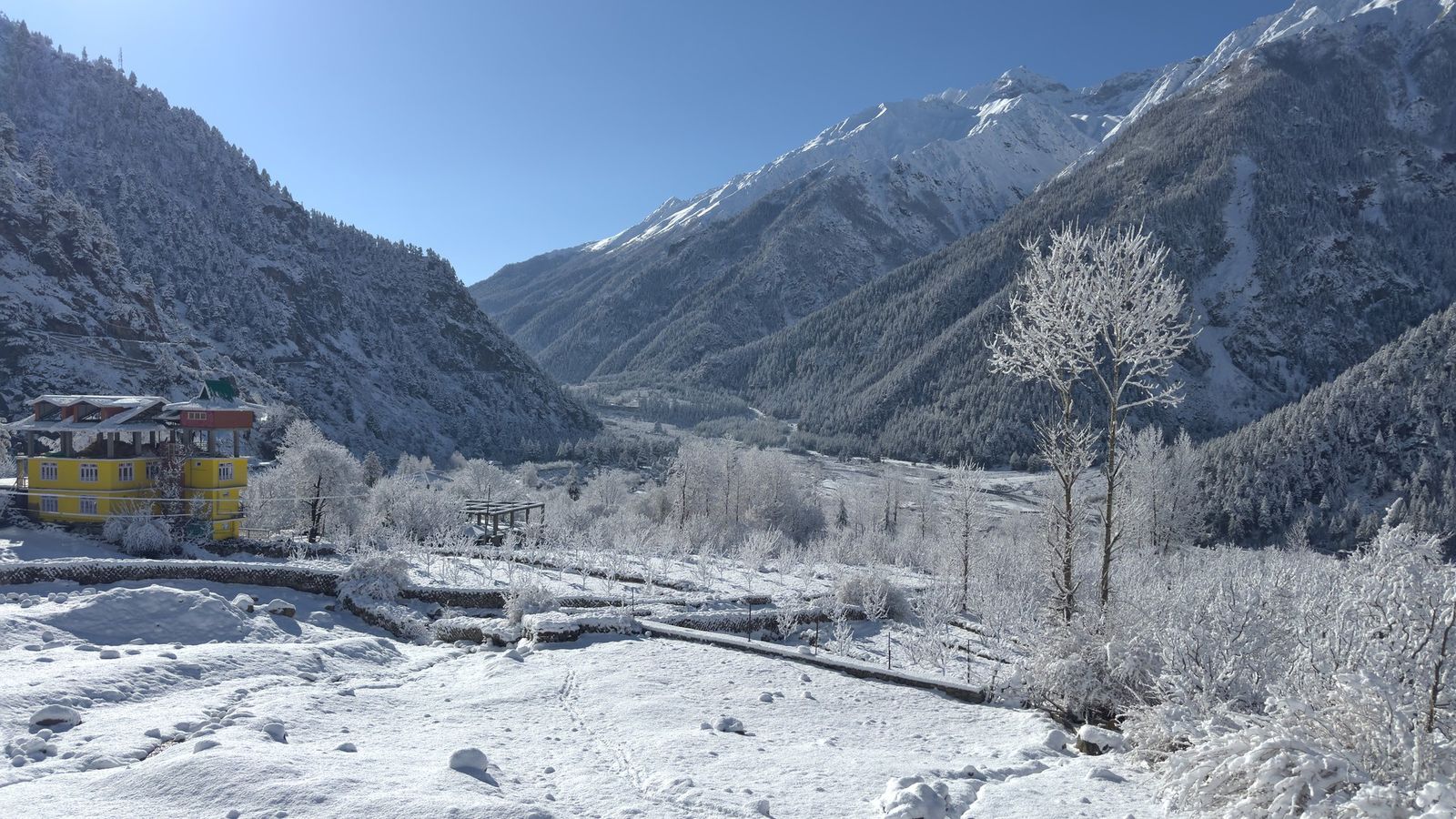
Photo: UnpetitproleX, CC BY-SA 4.0 (cropped), via Wikimedia Commons

A valley road in Himachal Pradesh, with apple orchards below and snow above.
In Himachal Pradesh, every district is a valley, and every valley has its own gods, its own dialect and its own apples.
The lower hills
Himachal Pradesh has twelve districts, climbing from the plains of Punjab to the Tibetan plateau. The southern ones, such as Una, Hamirpur, Bilaspur, Solan and Sirmaur, are low hills of pine and terraced fields. Shimla, the capital, was the summer capital of British India; the Kalka–Shimla railway, part of the Mountain Railways of India World Heritage Site, still climbs to it through more than a hundred tunnels.
Kangra, Kullu and Mandi
Kangra is a wide valley of tea gardens under the Dhauladhar range. Above it, Dharamshala and McLeod Ganj have been home to the Dalai Lama and a Tibetan community since 1960. Mandi, on the Beas river, is a town of old stone temples. Kullu is known for the Kullu Dussehra, when village gods are carried down to the valley for a week of fairs, beginning on Vijayadashami in October; regional calendars can shift the date. Manali, at the head of the Kullu valley, is the base for the high passes.
The high valleys
Chamba, in the north-west, is a quiet town of carved temples, embroidered handkerchiefs called Chamba rumal, and meadows at Khajjiar. Kinnaur, on the road to Tibet, grows some of India's finest apples below the Kinnaur Kailash range. Lahaul and Spiti is high, dry and Buddhist; the Atal Tunnel, opened in 2020, now links Lahaul to Manali all year, and the monastery at Key looks over the Spiti river.
Getting around
Shimla, Kangra and Kullu have small airports, but most visitors come by road from Chandigarh or Delhi. Mountain roads are slow, and landslides are common in the monsoon, from July to September. March to June and September to November are the best seasons; the high valleys are reachable only in summer by some routes.
The toy train to Shimla
Shimla became the summer capital of British India in 1864, and the railway followed. The Kalka–Shimla line opened on 9 November 1903: narrow gauge, 96.6 km long, climbing from the plains at Kalka to Shimla at over 2,000 metres. It was built with 103 tunnels, of which 102 are still in use, and more than 800 bridges. The longest tunnel, at Barog, is about 1.1 km. In 2008 UNESCO added the line to the Mountain Railways of India World Heritage Site.
The full journey takes around five to six hours. If that is too long, ride one section, such as Barog to Shimla. Book early in summer and at Christmas, when trains fill.
Permits for the high valleys
Indian citizens do not need permits for most of Kinnaur and Spiti. Foreign nationals do need a Protected Area Permit for the upper Pooh block of Kinnaur, including Nako, and for parts of Spiti, including Tabo and Dhankar. Kaza itself is open without one. The district administration in Kinnaur gives the fee at ₹200 a person, plus any travel-agency charge, and permits are issued by the district and sub-divisional offices at Reckong Peo, Pooh, Kaza and Shimla. Lower Kinnaur, including Sangla, Chitkul and Kalpa, needs no permit.
Rohtang Pass, above Manali, is controlled for vehicles rather than people. Each vehicle going up for tourism needs a one-day online permit, ₹500 for a car, plus a ₹50 congestion charge, and numbers are capped each day. The Atal Tunnel route to Lahaul does not need the Rohtang permit. For the temples district by district, see Himachal’s temples; for more, our guide to Himachal Pradesh.
Districts to know
- Shimla: the capital and the toy train.
- Kangra: tea gardens, Dharamshala and McLeod Ganj.
- Kullu: Manali and the Kullu Dussehra.
- Mandi: stone temples on the Beas.
- Chamba: carved temples and Khajjiar.
- Kinnaur: apples and the Kinnaur Kailash range.
- Lahaul and Spiti: high desert and monasteries.
In Himachal, the road always has another bend, and another village beyond it.
Plan your visit
| Best season | March to June and September to November. The monsoon, July to September, brings landslides. Kinnaur and Spiti are best from May to October; snow closes some passes in winter. |
|---|---|
| How to reach | By road from Chandigarh or Delhi, or by overnight bus to Manali or Dharamshala. Airports at Shimla (Jubbarhatti), Kangra (Gaggal) and Kullu (Bhuntar) have limited flights. Trains reach Kalka, Pathankot and Una. |
| Getting around | Hired car and driver, or the state HRTC buses, which go almost everywhere slowly. Allow more time than the map suggests: mountain roads average 25 to 30 km an hour. |
| Where to stay | Shimla’s Mall Road area or quieter Chotta Shimla; McLeod Ganj or Dharamkot in Kangra; Old Manali or Naggar in Kullu; Kaza in Spiti; Kalpa or Sangla in Kinnaur. |
| How long to spend | A week covers Shimla, Kangra and Kullu. Add a week for a loop through Kinnaur and Spiti. |
| Permits | Foreign nationals need a Protected Area Permit for upper Kinnaur (Pooh block) and parts of Spiti such as Tabo and Dhankar; fee ₹200 per person. Vehicles going up to Rohtang Pass need an online permit: ₹500 plus a ₹50 congestion charge for cars, as of October 2026. |
Questions people ask
How many districts are there in Himachal Pradesh?
Twelve: Bilaspur, Chamba, Hamirpur, Kangra, Kinnaur, Kullu, Lahaul and Spiti, Mandi, Shimla, Sirmaur, Solan and Una.
Do foreigners need a permit for Spiti and Kinnaur?
Yes, for the protected areas: the upper Pooh block of Kinnaur, including Nako, and parts of Spiti such as Tabo and Dhankar. Kaza and lower Kinnaur are open without one. Indian citizens do not need a permit.
How do I get a Rohtang Pass permit?
Online, on the Himachal government’s Rohtang permits site, for the vehicle, up to two days ahead. A car costs ₹500 plus a ₹50 congestion charge, and the number of permits each day is limited.
How long is the Kalka–Shimla toy train journey?
The line is 96.6 km long and the trip takes around five to six hours, through 102 tunnels.
What is the best time to visit Himachal Pradesh?
March to June and September to November for most of the state. The high valleys of Spiti and upper Kinnaur are best from May to October.
Read next
Written by Muthu, editor of Aura of India. Sources: UNESCO World Heritage Centre: Mountain Railways of India, District Kinnaur: Tourist guidelines and protected areas, Tourism Development Council Manali: Rohtang Pass permit fees, Government of Himachal Pradesh: Kalka Shimla Railway, history and facts. Last verified: 13 October 2026.
Your turn: Which Himachal district surprised you most, and how long did the road there really take?
Comments
Post a Comment
Comments are always welcome, that will help us to motivate ourselves and improve our services. Thanks!!