Chennakeshava Temple, Belur: Timings, Carvings and How to Visit
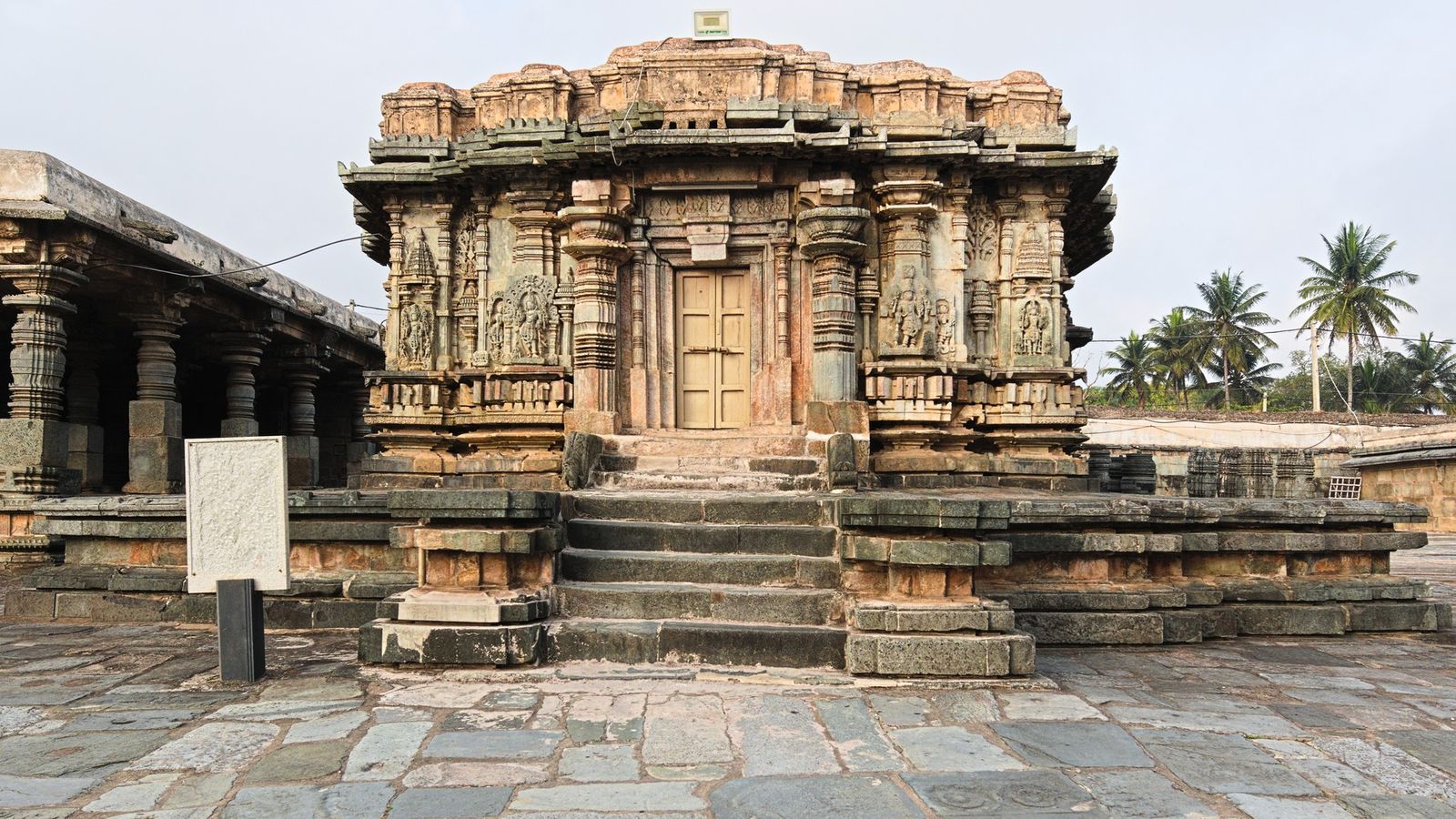
Photo: Rohit14400, CC BY-SA 4.0 (cropped), via Wikimedia Commons

The Chennakeshava temple at Belur, in Hassan district, soon after the doors open.
Belur’s carving is so fine that the only way to see it is to stand close and slow down.
A temple in soft stone
The Chennakeshava temple stands in a walled courtyard in Belur, a small town on the Yagachi river. A tall gopura, a gateway tower added in the Vijayanagara period, leads in from the street. Inside, the temple sits low on a wide stone platform. Its plan is shaped like a star, so the walls turn corner after corner and catch the light at different angles. The stone is chloritic schist, a grey-green soapstone soft enough to cut almost like wood. Bands of carving run round the base: a line of elephants at the bottom, then horses, then scrolls and scenes from the epics. Under the eaves lean bracket figures called madanikas, women dancing, hunting, playing music or looking into a mirror.
Still a place of worship
Belur is not a museum. Worship has gone on here since the temple was consecrated in 1117, and it still does. The Archaeological Survey of India looks after the stone, while the state’s religious endowments department runs the rituals. The doors open at 7.30 am. Families come for darshan, the sight of the deity, carrying flowers and coconuts to the sanctum, then sit for a while in the cool of the hall. Visitors share the same space. Shoes stay at the gate and voices stay low, and the courteous thing is to keep the camera away from the sanctum.
Why people come
The Hoysala king Vishnuvardhana built the temple to mark a victory over the Cholas in 1116, and it was first called Vijaya Narayana, Narayana of victory. Belur was then one of the Hoysala capitals. Tradition says the work went on for about 103 years, and names the master carvers as Dasoja and his son Chavana. Many sculptors signed their figures, cutting their names and home towns into the bases, which is rare in Indian temples. Inside, the lathe-turned pillars of the hall are polished almost black, and no two are alike. Queen Shantala is said to have been the model for Darpana Sundari, the lady with the mirror. In 2023 UNESCO listed Belur, with Halebidu and Somanathapura, as the Sacred Ensembles of the Hoysalas.
Getting there
Belur is about 38 km from Hassan, the nearest railway station, and buses run between the two. Bengaluru is about 220 km away by road and Mangaluru about 155 km; Mangaluru has the nearest airport. Hassan’s own airport is still being built. A taxi is the easiest way to join Belur with Halebidu, less than 20 km away, or with the coffee hills of Chikkamagaluru.
How to read one wall
Do not try to see everything. Choose one side of the temple and start at the bottom. The elephants in the lowest band stand for strength, the horses above them for speed; above those run the scrolls and the panels of gods and stories. Then look up to the brackets under the eaves, and down again to the base of each figure, where a sculptor may have cut his name.
Inside, the carving is finer still. The Narasimha pillar in the hall is said to have once turned on its base. Outside the main shrine stands a tall lamp pillar said to rest on its own weight. Smaller shrines fill the courtyard, among them Kappe Chennigaraya, Soumyanayaki and Andal. One wall studied well teaches more than a fast lap of the whole complex.
Halebidu, the next morning
Halebidu, once Dwarasamudra, was the later Hoysala capital, less than 20 km from Belur. Its Hoysalesvara temple is a pair of Shiva shrines side by side, set near a large tank, and carved even more densely on the outside than Belur. Unlike Belur, it is no longer in daily worship, and the quiet changes how it feels. A small Archaeological Survey museum on the site has its own ticket.
Belur in the morning and Halebidu in the afternoon works well, since Belur closes briefly at midday. The third UNESCO temple, the Keshava temple at Somanathapura, is near Mysuru. For more of the state’s temples, read Karnataka’s temples, from Hampi to Belur.
Before you go
- Timings: 7.30 am to 7.30 pm, with a short closure around midday; check at the gate.
- Entry: no ticket for darshan; parking, guides and sevas, paid offerings, cost extra.
- Dress: cover shoulders and knees; shoes come off at the entrance, so the courtyard is walked barefoot.
- Arrive early: the stone is cooler underfoot and the courtyard quieter before the tour coaches.
- Take a guide: a good one points out the sculptors’ signatures; agree the fee first.
- Allow two hours: enough for one slow circuit outside and the hall inside.
Stand close enough and the water drops on a dancer’s wet hair are there in the stone.
Plan your visit
| Entry fee | No ticket for darshan, as of October 2026. Parking, guides and sevas are paid; check rates at the temple office. |
|---|---|
| Opening hours | Daily, 7.30 am to 7.30 pm, with a short midday closure. The temple department lists 1 to 1.30 pm; some listings say until 2.30 pm. Check at the gate. |
| Best time | October to February, when the weather is mild. Early morning for quiet and soft light. |
| How to reach | By road: about 38 km from Hassan, 220 km from Bengaluru and 155 km from Mangaluru. Buses run from Hassan; a taxi suits Belur with Halebidu. |
| Nearest airport and station | Mangaluru airport. Hassan Junction railway station. |
| Where to stay | Belur town for an early start; Hassan for more choice; a coffee-estate homestay near Chikkamagaluru. |
| Dress and rules | Shoulders and knees covered. Shoes off at the entrance. Keep voices low and the camera away from the sanctum. |
Questions people ask
Is there an entry fee at Belur temple?
No ticket is sold for darshan, as of October 2026. Parking, guides and sevas, the paid offerings, cost extra.
Can I see Belur and Halebidu in one day?
Yes. They are less than 20 km apart. See Belur first, while it is open in the morning, and Halebidu in the afternoon.
Why are the Belur carvings so detailed?
The Hoysala carvers worked in chloritic schist, a soft soapstone that takes very fine cuts. Many of them signed their figures.
Why is Belur a UNESCO World Heritage Site?
In 2023 UNESCO listed Belur, Halebidu and Somanathapura together as the Sacred Ensembles of the Hoysalas, for their star-shaped plans, carved friezes and sculpture covering every surface.
Read next
Written by Muthu, editor of Aura of India. Sources: UNESCO World Heritage Centre: Sacred Ensembles of the Hoysalas, Karnataka Tourism: Chennakeshava Temple, District Hassan, Government of Karnataka: Chennakeshava Temple, Belur, Karnataka HRCE Department: Shri Channakeshava Swami Temple, Belur (timings), Impart: Madanikas at Chennakeshava Temple, Belur, The New Indian Express: delays to Hassan airport (February 2026). Last verified: 15 October 2026.
Your turn: Which single figure at Belur made you stop the longest, and did you find a sculptor’s name on its base?
Comments
Post a Comment
Comments are always welcome, that will help us to motivate ourselves and improve our services. Thanks!!