Bishnupur Terracotta Temples: History, Tickets and How to Visit
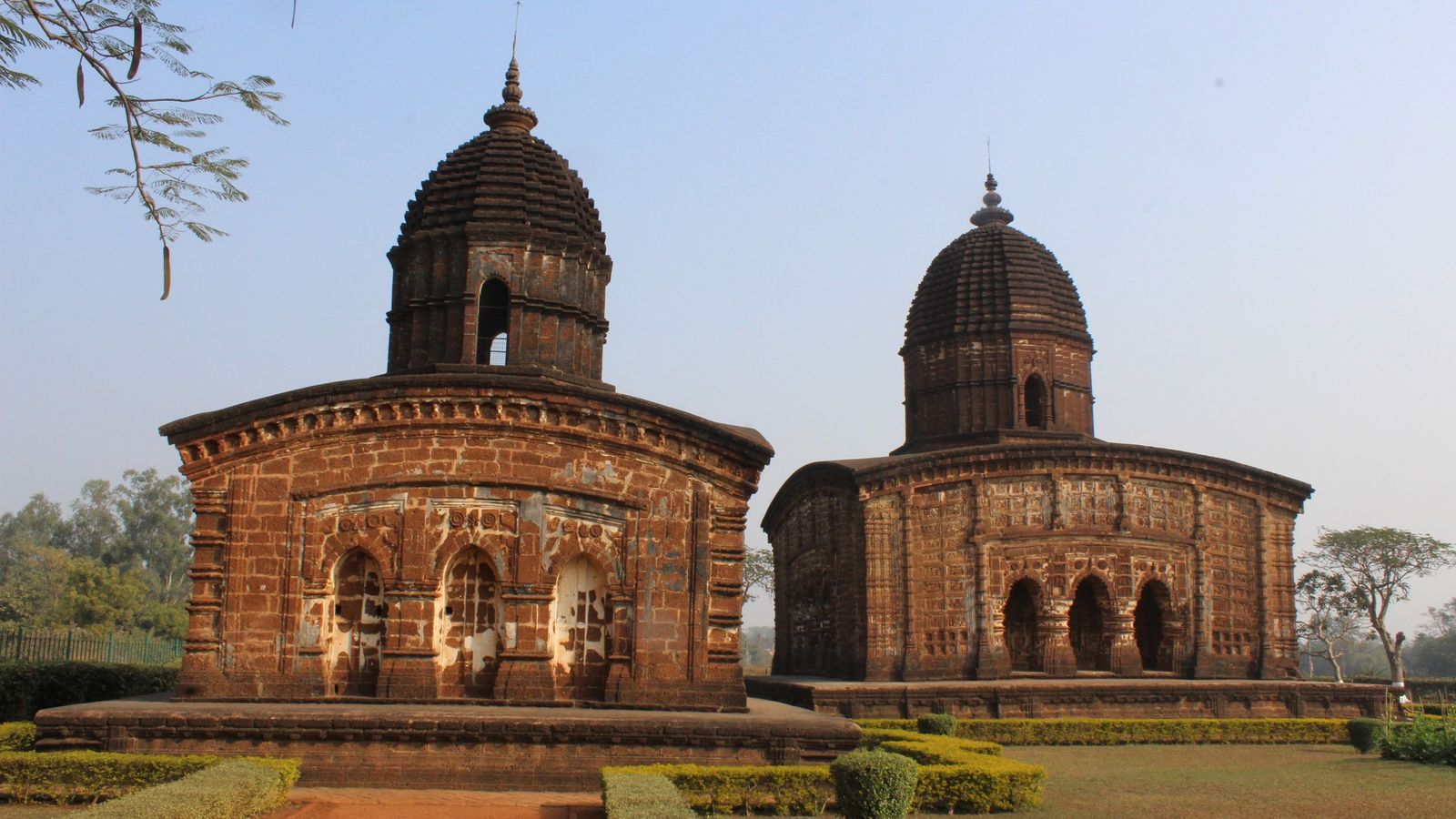
Photo: SuvadipSanyal, CC BY-SA 4.0 (cropped), via Wikimedia Commons

Bishnupur, in the Bankura district of West Bengal, late afternoon.
Brick and clay, not stone, and every wall tells a story.
Temples of fired clay
Bengal has little stone, but it has clay. The finest temples of Bishnupur are built of brick and faced with terracotta, clay panels carved and then fired. Every surface tells a story: scenes from the Ramayana and the Mahabharata, Krishna with the cowherd girls, hunts, boats, battles, musicians and everyday life. The roofs curve like the thatched huts of a Bengal village. In the late light the red deepens.
A town still making things
Bishnupur is not only a site. The town still makes what it is known for. The Baluchari sari, woven here with scenes from the epics along its border, is sold in the town. In the nearby village of Panchmura, potters make the Bankura horse, a long-necked terracotta horse that has become a symbol of Bengal’s crafts. Bishnupur even has its own school of classical music, the Bishnupur gharana.
Why people come
The temples were built by the Malla kings in the seventeenth and eighteenth centuries, when Bishnupur was a rich kingdom and a centre of devotion to Krishna. The Rasmancha, a pyramid-shaped platform where images were shown to the public at festivals, dates from about 1600. The Jor Bangla temple, two hut-shaped roofs joined together, is one of the most photographed buildings in Bengal. The town is on UNESCO’s tentative list.
Getting there
Bishnupur is about 150 kilometres west of Kolkata, and trains from Howrah take about four hours. The temples are spread around the town. A cycle rickshaw or an auto can take you from one to the next, and one ticket covers the main protected temples.
Reading three temples
Start at the Rasmancha, from about AD 1600. It is not a temple with a single shrine but a platform: a pyramid-shaped roof on a wide laterite base, with a small sanctum ringed by three galleries of arches. During the Ras festival, images of Krishna from the town's temples were brought here and shown to the people.
The Shyam Rai temple, from 1643, is a pancha-ratna, with five towers on its roof. Its walls carry some of the densest terracotta in the town: Krishna with the gopis, scenes from the Ramayana, a circle of dancers. Walk all four sides. The best panels are not always on the front.
The Jor Bangla, from 1655, is two do-chala roofs, each shaped like the two slopes of a village hut, set side by side and joined, with a char-chala tower on top. Many of the other temples are of a simpler type, a single tower on a sloping roof, and some are built of laterite rather than brick, with plainer carving.
Saris, horses and a day plan
Baluchari saris are woven in Bishnupur on jacquard looms, with whole scenes from the epics in silk along the pallu. Ask in the town's weaving lanes and shops, and expect to pay more for silk than for cotton. Panchmura, the village where the Bankura horse is made, is a short drive away. Go in the morning and ask to see the kilns.
A good day: arrive on the morning train, see the Rasmancha and the Shyam Rai before the sun is high, go to Panchmura or the weavers at midday, and return to the Jor Bangla and the smaller temples in the late afternoon. Stay the night if you can. Back in Kolkata, kantha is another of Bengal's living crafts.
Among the temples
- Go in the late afternoon, when the light is low on the panels.
- Stand close to one panel and read it like a page.
- Buy a Baluchari sari or a Bankura horse where they are made.
- Do not touch the terracotta. The panels are fragile.
At sunset the walls turn the colour of a pot fresh from the kiln.
Plan your visit
| Entry fee | One combined ticket for the main protected temples: ₹25 for Indian, SAARC and BIMSTEC visitors, ₹300 for other foreign visitors; children under 15 free. As of October 2026; check at the gate. |
|---|---|
| Opening hours | Roughly sunrise to sunset, about 6 am to 6 pm. Check at the gate. |
| Best time | October to March. Late afternoon for the light on the panels. Early in the day for fewer people. |
| How to reach | Trains from Howrah or Santragachi take about three to four hours. Then a cycle rickshaw, an auto or a toto between the temples. |
| Nearest airport and station | Kolkata airport, about 150 km away. Bishnupur station is on the line between Howrah and Purulia. |
| Where to stay | In Bishnupur town, close to the temples. Stay overnight to see them at both ends of the day. |
| Dress and rules | Do not touch or climb on the terracotta. Some temples are still in worship: dress modestly and remove shoes where asked. |
Open Rasmancha, Bishnupur, Bankura, West Bengal in Google Maps
Questions people ask
How much is the ticket for the Bishnupur temples?
One combined ticket covers the main protected temples, including the Rasmancha, Shyam Rai and Jor Bangla. It is ₹25 for Indian, SAARC and BIMSTEC visitors and ₹300 for other foreign visitors, as of October 2026. Check at the gate.
How do I get from Kolkata to Bishnupur?
By train. Express trains from Howrah and Santragachi take about three to four hours. Take an early one to have the full day.
Is Bishnupur a World Heritage Site?
Not yet. The Archaeological Survey of India placed the temples of Bishnupur on UNESCO's Tentative List in 1998, which is the first step towards nomination.
Can I do Bishnupur as a day trip from Kolkata?
It can be done, but it is long: six to eight hours on trains. One night lets you see the temples in the morning and in the late afternoon, which is when the terracotta looks its best.
Read next
Written by Muthu, editor of Aura of India. Sources: UNESCO World Heritage Centre Tentative List: Temples at Bishnupur, West Bengal, India Guide: Bishnupur timings and entry fees (secondary listing). Last verified: 13 October 2026.
Your turn: Which Bishnupur temple has the panel you remember best, and what does it show?
Comments
Post a Comment
Comments are always welcome, that will help us to motivate ourselves and improve our services. Thanks!!