Kolkata at Dawn: Howrah Bridge, Mullick Ghat and the Hooghly
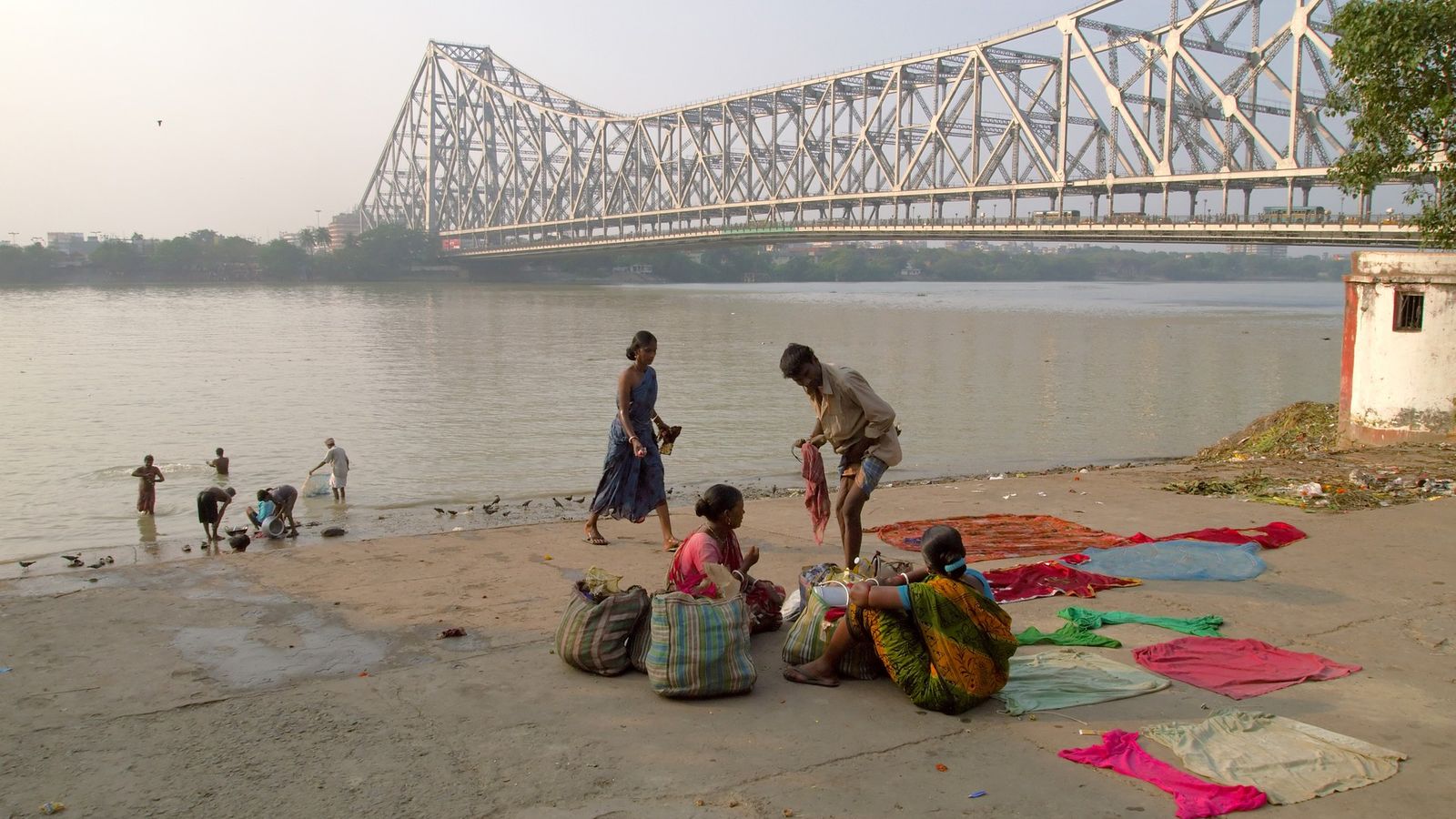
Photo: Vyacheslav Argenberg, CC BY 4.0 (cropped), via Wikimedia Commons

The Hooghly River in Kolkata, at first light.
Dawn is the hour Kolkata agrees to be quiet.
A river already at work
Kolkata sits on the east bank of the Hooghly, a branch of the Ganges, and the city’s morning starts at the water. Men bathe and exercise on the ghats, the stone steps down to the river. Ferries cross to Howrah on the far bank. Over it all hangs the Howrah Bridge, a huge steel cantilever opened in 1943 and held together with rivets rather than nuts and bolts. In the early light it is a shape, not yet a traffic jam.
Flowers under the bridge
At the foot of the bridge, on the city side, is the Mullick Ghat flower market, one of the largest in Asia. From before dawn, farmers and traders bring in marigolds by the sackful, strung into garlands the colour of the rising sun, with lotus, tuberose and roses for temples and weddings. By nine the best is gone. A short ride north, in the lanes of Kumartuli, clay images are being made for the October festival.
Why people come
For nearly 140 years Kolkata, then Calcutta, was the capital of British India, and it still has the grandest colonial buildings in the country, beside old Bengali mansions and the markets of the north. It is a city of writers, argument and cheap, good food. Visitors from abroad come for its atmosphere, for Mother Teresa’s house and the Victoria Memorial. Indians come for the festival, the food, and the bookstalls of College Street.
Getting to the river
Kolkata’s airport has flights from across India and from Bangkok, Dhaka, Singapore and the Gulf. Howrah and Sealdah are the main railway stations. One metro line runs under the Hooghly, the first underwater metro in India, between Howrah and Esplanade. For Mullick Ghat, take a taxi to the Howrah Bridge before sunrise, or cross on a ferry from Howrah.
A sunrise walk by the river
In October the sun rises at about half past five, so leave by five. Start at the Mullick Ghat flower market, on the Kolkata side under the eastern end of the bridge, while the sacks of marigolds are still being opened. Then climb the steps onto the bridge. Its footpaths, one on each side, are wide enough to stop on, and they carry several lakh people a day.
Walk out to the middle for the view south down the river, then come back or carry on to Howrah station on the far bank. From the station side, the short ferry back across gives you the whole bridge from the water. Afterwards, take a taxi north to Kumartuli, the potters' quarter, or south along the river to Prinsep Ghat, a small classical pavilion from the 1840s with the cable-stayed Vidyasagar Setu behind it.
By eight the traffic is heavy and the light is flat. That is the time for tea and breakfast, and for the sweet shops of north Kolkata, which open early.
The bridge, in a few numbers
The Howrah Bridge replaced a pontoon bridge that had to be opened to let ships through. Work was under way by 1936, under the Port Commissioners, and it opened on the night of 3 February 1943 with no ceremony at all: a single tram rolled across. The war was close. Japanese planes had bombed the city in December 1942.
It is a balanced cantilever, with a central span of about 1,500 feet between the two main towers. It took 26,500 tons of steel, most of it high-tensile steel from Tata Steel, and was riveted throughout. In 1965 it was renamed Rabindra Setu after Rabindranath Tagore, though almost nobody calls it that. The port still maintains it.
At dawn
- Arrive by six. The flower market is busiest before sunrise.
- Wear shoes you do not mind getting wet. The market floor is water and petals.
- Take the short ferry across the river for the best view of the bridge.
- Ask before photographing the traders.
By eight the horns start and the bridge fills. The quiet does not last, which is why it is worth getting up for.
Plan your visit
| Best season | October to March, when mornings are cooler and the air clearer. Sunrise in mid-October is around 5.30 am. |
|---|---|
| How to reach | Kolkata airport has flights across India and abroad. Howrah station is at the western end of the bridge; the Green Line Metro runs under the river to Howrah station. For Mullick Ghat, take a taxi to the Kolkata end of the bridge. |
| Getting around | Walk across the bridge, take the ferry back, and use taxis or app cabs for Kumartuli and Prinsep Ghat. The Metro starts running too late for sunrise. |
| Where to stay | BBD Bagh and Esplanade are closest to the river. Park Street and the streets around it are a short taxi ride away. |
| How long to spend | Two hours at dawn for the market, the bridge and the ferry. Three days for the city. |
Open Mullick Ghat Flower Market, Kolkata, West Bengal in Google Maps
Questions people ask
What time does the Mullick Ghat flower market open?
It trades almost round the clock, but the wholesale rush is from before dawn until about nine. Arrive between five and seven for the most flowers.
Can you walk across the Howrah Bridge?
Yes. There is a footpath on each side, and lakhs of people cross on foot every day. It takes about fifteen to twenty minutes at an easy pace.
Is there a metro under the Hooghly?
Yes. The Green Line runs under the river between Howrah and Esplanade. It was India's first under-river metro tunnel, opened in March 2024, and Howrah is the deepest metro station in the country.
Where is the best view of the Howrah Bridge?
From the water. The ferry between Howrah and the Kolkata bank passes close to the bridge, and the ghats just north of the flower market look straight at it.
Read next
Written by Muthu, editor of Aura of India. Sources: Howrah District, Government of West Bengal: Mullick Ghat Flower Market, The Hindu: Spine of steel, Howrah Bridge at 75, Press Information Bureau: Howrah Maidan-Esplanade section, India's first underwater metro (6 March 2024). Last verified: 13 October 2026.
Your turn: Have you crossed the Howrah Bridge on foot at dawn? Which way did you walk, and what did you see?
Comments
Post a Comment
Comments are always welcome, that will help us to motivate ourselves and improve our services. Thanks!!