Srikalahasti and Pedana Kalamkari: How It Is Made, Where to Buy
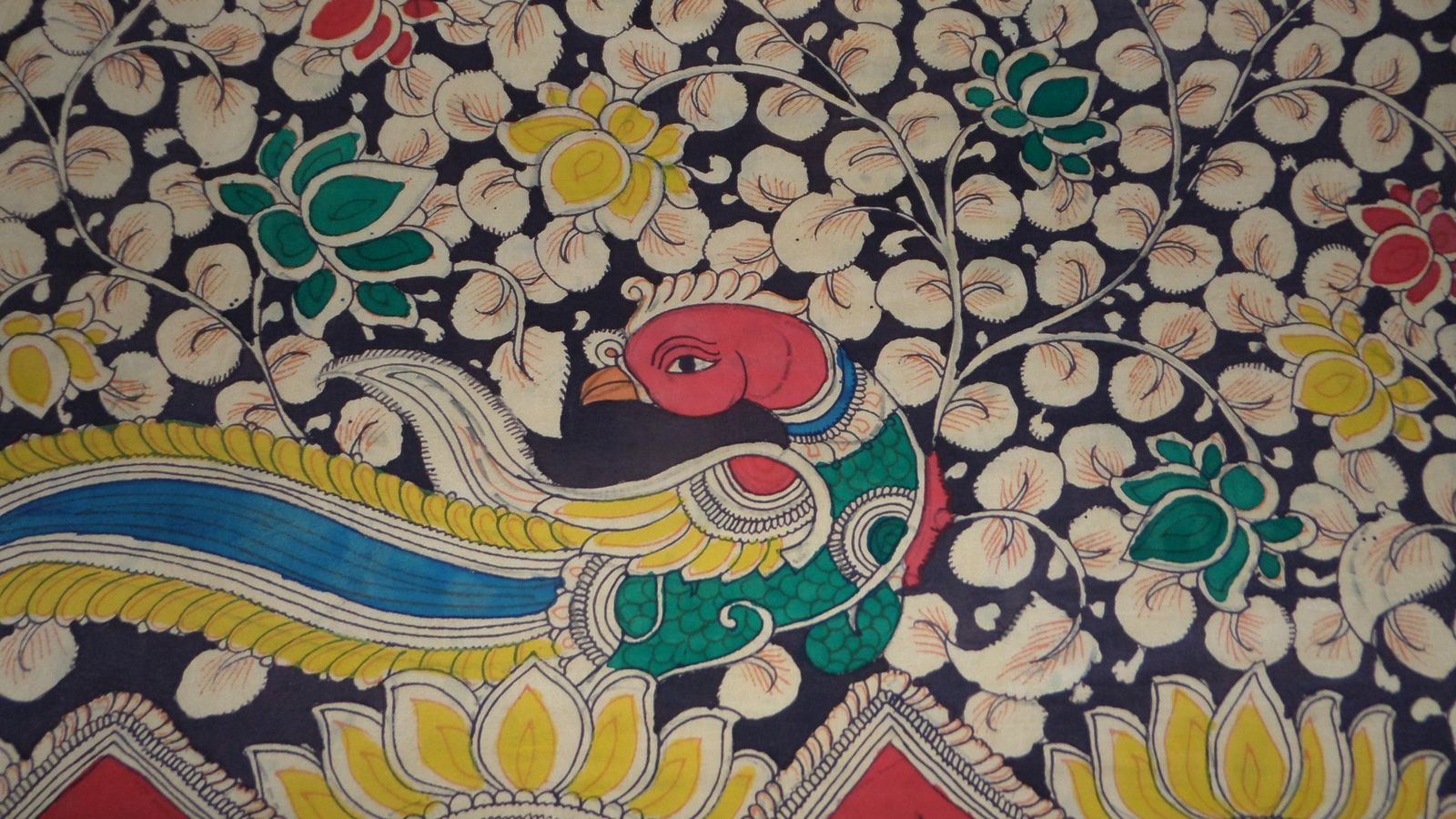
Photo: rajaraman sundaram, CC BY 3.0 (cropped), via Wikimedia Commons

Srikalahasti on the Swarnamukhi river, and Pedana near the port of Machilipatnam, Andhra Pradesh.
In Srikalahasti the cloth is drawn line by line, in Pedana it is printed block by block, and in both towns it waits on the sun and the water.
Two cloths, one name
Kalamkari means pen-work, from the Persian kalam, a pen, and kari, craft. In Andhra Pradesh it lives in two towns far apart. Srikalahasti is a temple town in Tirupati district, near the Tamil Nadu border. Here artists draw freehand on cotton with a bamboo pen. Large panels tell the Ramayana or the Mahabharata in rows of small, rounded figures, outlined in black on a deep red ground.
Pedana lies on the Krishna delta, about 13 km from Machilipatnam. Here the design is carved into wooden blocks and pressed onto the cloth. The patterns repeat: creepers, trees, birds and arched niches, printed by the metre for bedcovers, sarees and dress fabric.
A slow recipe
Both styles start the same way. The cotton is washed, then soaked in myrobalan, a dried fruit rich in tannin, mixed with buffalo milk, which stops the colours spreading. In Srikalahasti the artist sketches with charcoal made from tamarind twigs, then traces the lines with kasim, a black made from rusted iron and jaggery left to ferment for about three weeks. Wherever red is wanted, alum is painted on as a mordant, a fixing agent. The cloth is boiled in a red dye bath, and only the alum areas keep the colour. Washing, drying and painting in yellow and blue follow; a painted saree can take up to 50 days.
In Pedana the same chemistry runs at workshop scale. In the karkhanas, the workshops, printers stamp the outline and the alum paste with blocks, and the cloth moves on to the dye vat, the washing tank and the drying ground.
Temple cloth and trade cloth
Srikalahasti's painted cloths were made for temples: wall hangings and chariot banners, full of gods and epic scenes. By the mid-twentieth century the craft had almost died out. In 1957 a training centre, backed by the crafts reformer Kamaladevi Chattopadhyay, began teaching it again under the painter J. Lakshmaiah, and most painters today trace their training back to it.
Machilipatnam's story is a port's story. It was the main port of the Golconda sultans, and by 1700 its painted and printed cottons were known from Delhi to London. The Dutch called them sits, the English chintz. Persian, Arab and European buyers all shaped the designs. Both styles are now registered Geographical Indications, a legal mark that ties a craft to its place.
Getting there
Srikalahasti has its own railway station, and Tirupati airport at Renigunta is a short drive away; many visitors pair it with the town's Srikalahasteeswara temple or with Tirumala. For Pedana, travel to Vijayawada by air or rail, then on to Machilipatnam by train or road. Workshops are working places, not showrooms. Ask before you step in, and come in the morning, when cloth is going into the dye or out to dry.
Pen and block, side by side
A Srikalahasti panel is read like a book. Scenes run in bands across the cloth, each figure short and rounded to fit its frame, and the red ground makes the black outlines stand out. A master designs and draws; assistants fill in colour, often several of them on one cloth at once.
A Pedana print is read like a garden. One block carries the black outline, others the mordant for each colour, and the printer lines them up by eye down the cloth. Old Machilipatnam designs, the tree of life, flowering creepers and arched prayer-mat shapes, were made for buyers overseas and are still printed today.
Buying where it is made
In both towns many workshops sell from a front room, which puts the most money in the makers' hands. Pedana sells by the metre and by the piece: bedcovers, table linen, dupattas and sarees. Srikalahasti sells painted panels, sarees, stoles and wall hangings. Lepakshi, the state handicrafts emporium, stocks both in Andhra Pradesh's cities.
Screen-printed copies in synthetic colours are sold everywhere as kalamkari. Srikalahasti is also a temple town; for its great Shiva temple and others, read Andhra Pradesh's temples and the Andhra Pradesh guide.
Before you go
- Ask which kind: hand-drawn from Srikalahasti or block-printed from Pedana; both are real, and priced very differently.
- Look at the back: dyed cotton shows its colour through, while a surface print stays pale on the reverse.
- Follow a line: a pen line thickens and thins; a block shows small breaks where the repeats meet.
- Ask for the GI label: makers registered under the Geographical Indication can show it.
- Wash it gently: cold water, mild soap, alone the first time, and dry it in the shade.
On the drying ground, a long red cloth lies flat in the sun, its black lines waiting for the next colour.
Plan your visit
| Where to see it made | Srikalahasti, in Tirupati district, for hand-drawn work; Pedana, about 13 km from Machilipatnam in Krishna district, for block prints. |
|---|---|
| Where to buy | Workshops in both towns, and Lepakshi, the state handicrafts emporium, in Andhra Pradesh's cities. |
| Price guide | A hand-drawn piece costs several times a block print of the same size, because a large panel or saree can take weeks. Check before you buy. |
| How to tell the real thing | If a 'hand-painted' saree is cheap, it is printed. Real work has living lines, colour soaked through and a GI label from a registered maker. |
| Getting there | Srikalahasti has a railway station, with Tirupati airport at Renigunta close by. For Pedana, go via Vijayawada to Machilipatnam. |
| Best season | November to February, when it is dry and cooler; dyeing and drying slow down in heavy rain. |
Open Pedana, Krishna district, Andhra Pradesh in Google Maps
Questions people ask
What is the difference between Srikalahasti and Machilipatnam kalamkari?
Srikalahasti kalamkari is drawn and painted by hand with a bamboo pen, usually with figures and stories. Machilipatnam kalamkari, made in Pedana, is printed with carved wooden blocks in floral and geometric repeats.
Is kalamkari made with natural dyes?
Traditionally, yes: myrobalan, alum, iron black, red from plant roots, and indigo. Some workshops now use alizarin, a synthetic form of the old red, and copies use chemical colours throughout. Ask what was used.
Does kalamkari have a GI tag?
Both styles do. Srikalahasthi Kalamkari and Machilipatnam Kalamkari are separate registered Geographical Indications, each tied to its own area.
Can visitors watch kalamkari being made?
Often, yes, but workshops are private and busy. Ask first, go in the morning, and buy something if you take up a maker's time.
Read next
Written by Muthu, editor of Aura of India. Sources: Geographical Indications Registry: Srikalahasthi Kalamkari, Geographical Indications Registry: Machilipatnam Kalamkari, Krishna District, Government of Andhra Pradesh: One District One Product, Pedana kalamkari, Office of the Development Commissioner (Handicrafts): Kalamkari, Tirupati District, Government of Andhra Pradesh: mandals, Sahapedia: Kalamkari, an introduction, Deccan Heritage Foundation: The qalamkari textiles of Golconda. Last verified: 15 October 2026.
Your turn: Do you own a piece of kalamkari? Is it pen-drawn from Srikalahasti or block-printed from Pedana, and how has it worn?
Comments
Post a Comment
Comments are always welcome, that will help us to motivate ourselves and improve our services. Thanks!!