Kantha Embroidery of Bengal: Where to See and Buy Real Kantha
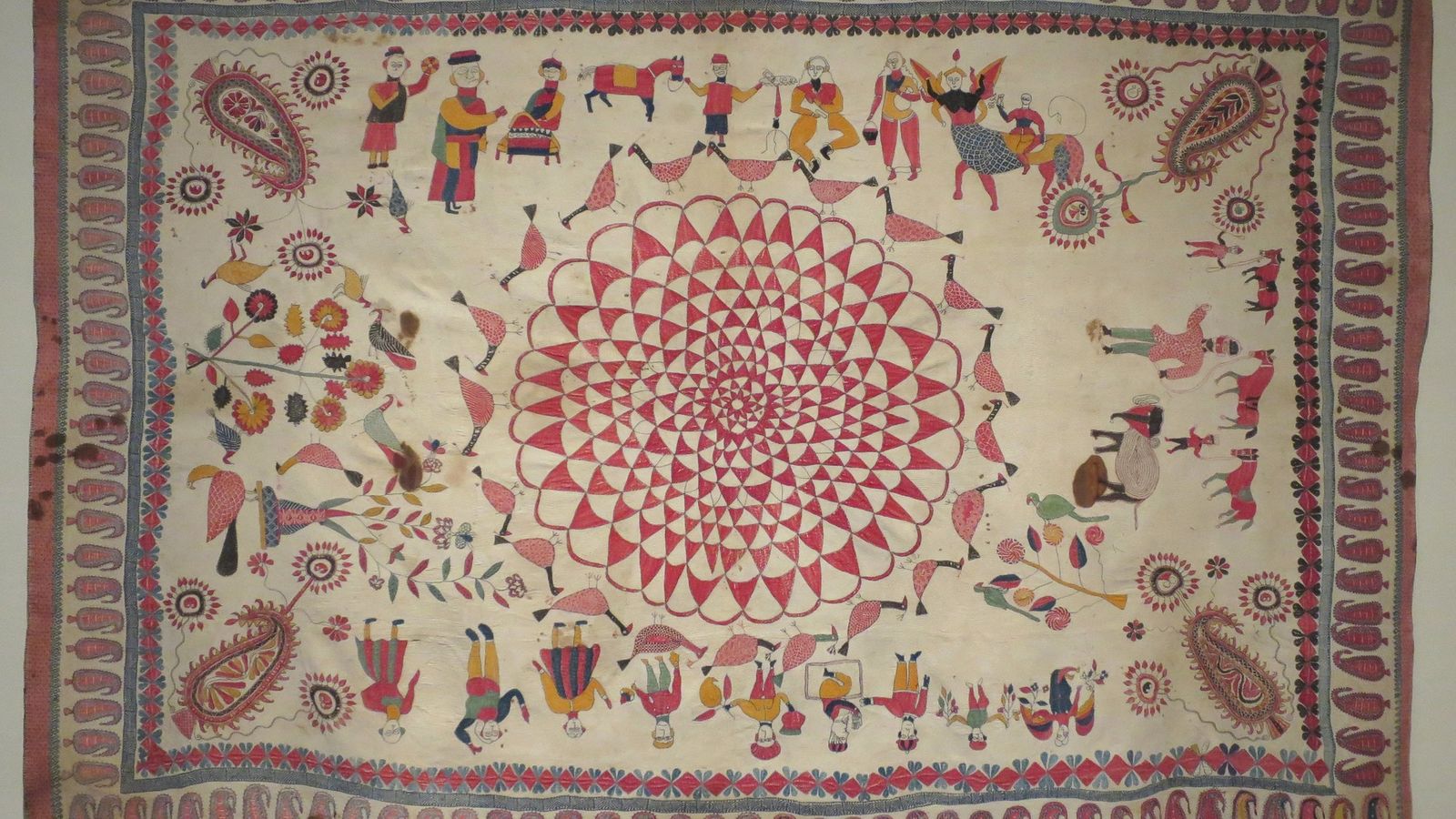
Photo: Hiart, CC0 (cropped), via Wikimedia Commons

A kantha quilt spread flat on a bed in Bengal.
Old saris, layered and stitched until they become something new.
A running stitch
Kantha is a quilt made of old cloth. Layers of worn saris and dhotis are laid one on another and held together with a running stitch, a line of small, even stitches. The stitches cover the whole surface, so the quilt ripples a little when you run your hand over it. Threads are often pulled from the borders of the old saris themselves. The colours are soft: white, red, blue, black.
What it is for
In Bengal, kantha has always been household cloth. It is a light quilt for winter, a wrap for a newborn, a cover for a book or a mirror, a bag for small things. Mothers and grandmothers stitched them in the afternoons, often for a wedding or a birth. A family might keep its best kanthas for generations. Today the same stitch is worked on silk saris, stoles and cushion covers sold across India.
The pictures in the cloth
The finest old kanthas are called nakshi kantha, kantha with designs. Many have a lotus at the centre, a tree of life at the corners, and a border of waves. Between them the women stitched what they saw: fish, birds, elephants, boats, a village wedding, a train. No two are the same. Bangladesh and West Bengal share the tradition, which was carried on across the border after 1947.
Where to see and buy it
In Kolkata, the Gurusaday Museum at Joka holds one of the best collections of old kantha, though it has been closed to visitors since 2020. For new work, go to Santiniketan, three hours from Kolkata by train, where the Saturday market at Sonajhuri has stalls run by the women who stitch. Government craft shops in Kolkata sell pieces with a fixed price and a label telling you who made them.
Where the old kanthas are
The largest collection of old kantha in West Bengal belongs to the Gurusaday Museum at Joka, on the southern edge of Kolkata. It holds around 3,300 objects of Bengal's folk art, gathered by Gurusaday Dutt, a civil servant and folklorist, while he served in the districts of undivided Bengal. Among them are nakshi kanthas from before Partition. Sadly, the museum lost its central government grant in 2017, has been closed to visitors since June 2020, and in August 2026 it was still locked.
Until it reopens, the place to see old kantha in Kolkata is the Asutosh Museum of Indian Art, founded by the University of Calcutta in 1937, in the university's College Street campus. Its folk art collection includes embroidered kanthas. The Victoria Memorial also has a fine embroidered kantha in its collection.
Santiniketan and the Saturday haat
Santiniketan, where Rabindranath Tagore founded his school and later his university, became a UNESCO World Heritage Site in 2023. Tagore's circle encouraged the revival of village crafts, and the women's craft groups around the town still stitch kantha on silk and cotton.
The weekly market, Sonajhuri Haat, is held on Saturday afternoons, from about three until sunset, among the trees of the Khoai, a stretch of red, eroded laterite near the Kopai river. A smaller haat runs on Sunday mornings. Sellers spread their work on cloth on the ground: kantha stoles and saris, jewellery, paintings, and food, with Baul singers performing nearby. Go in the cooler months and arrive by three for the full haat.
Before you buy
- Turn the piece over. Hand stitching shows on the back, slightly uneven.
- Printed fabric made to look stitched is flat to the touch.
- Silk kantha saris take weeks to make. A very low price usually means machine work.
- Wash an old kantha by hand in cold water, and dry it in the shade.
Hold a kantha up to the window and the light comes through every stitch, like a field seen from above.
Plan your visit
| Where to see it made | In Santiniketan and the villages of Birbhum, where women's craft groups stitch kantha. In Kolkata, see old pieces at the Asutosh Museum of Indian Art on College Street (weekdays only; check before you go). |
|---|---|
| Where to buy | Sonajhuri Haat in Santiniketan on Saturday afternoons; government craft emporiums in Kolkata for fixed prices. |
| Price guide | It depends on the cloth and how dense the stitching is. Cotton stoles cost least, silk saris worked all over cost most. Compare several stalls; no reliable 2026 price list could be found. |
| How to tell the real thing | Turn it over: hand stitches show on the back, small and slightly uneven. Run your hand across it: real kantha ripples. Printed imitations are flat. |
| How to care for it | Hand-wash in cold water, dry flat in the shade, and fold rather than hang. |
Open Sonajhuri Haat, Santiniketan, Birbhum, West Bengal in Google Maps
Questions people ask
What is nakshi kantha?
Kantha with pictures. The quilt is filled with figures and patterns, often a lotus in the centre, trees in the corners and a border of waves, with scenes of daily life between them.
Is the Gurusaday Museum open?
No. It has been closed to visitors since June 2020, and reports in August 2026 said it was still locked. See old kantha at the Asutosh Museum of Indian Art instead.
When is Sonajhuri Haat held?
Every Saturday afternoon, from about 3 pm until sunset, with a smaller haat on Sunday mornings. Some sellers come on other days too.
How can I tell hand kantha from machine work?
Look at the back. Hand stitches are small, a little uneven, and pass through all the layers. Machine stitches are perfectly regular, and printed kantha has no stitches at all.
Read next
Written by Muthu, editor of Aura of India. Sources: The Theorist: Folk history in limbo, artefacts at Gurusaday Museum await revival, Ei Samay: Gurusaday Museum faces neglect (7 August 2026, in Bengali), UNESCO World Heritage Centre: Santiniketan, Santiniketan.com: Sonajhuri Haat (Khoai Mela). Last verified: 13 October 2026.
Your turn: Do you have a family kantha at home? Who stitched it, and what pictures are in it?
Comments
Post a Comment
Comments are always welcome, that will help us to motivate ourselves and improve our services. Thanks!!