Sundarbans Tiger Reserve: Permits, Fees and How to Visit by Boat
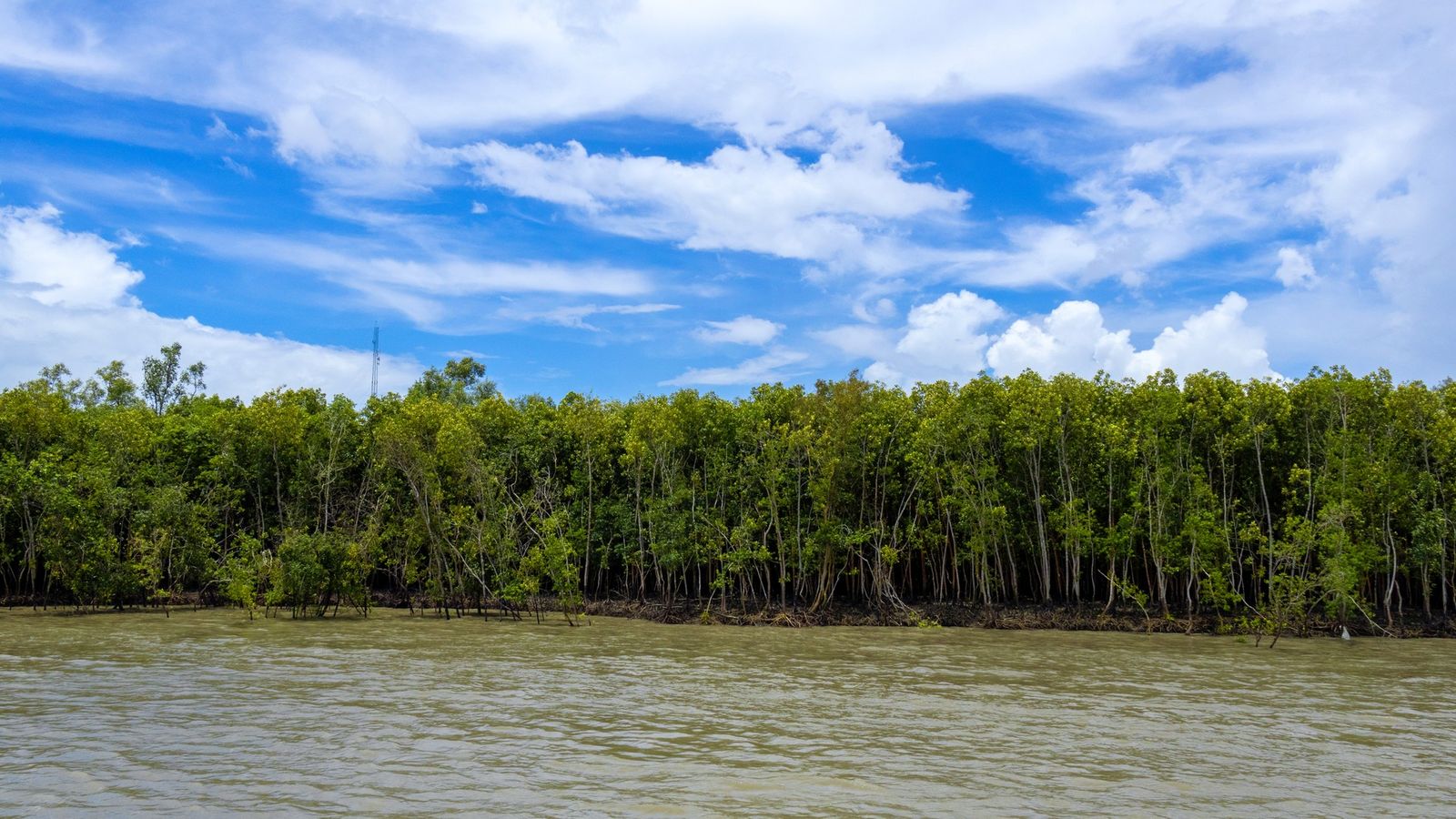
Photo: Kingshuk Mondal, CC BY 4.0 (cropped), via Wikimedia Commons

The Sundarbans, on a narrow creek at high tide.
There is no viewpoint. There is only the next bend.
A forest in the tide
Where the Ganges, the Brahmaputra and the Meghna reach the Bay of Bengal, they split into hundreds of channels and islands covered in mangrove, trees that grow in salt water and breathe through roots that poke up out of the mud. This is the Sundarbans, the largest mangrove forest in the world, shared between India and Bangladesh. Twice a day the tide comes in and the forest floor disappears.
Living with the tiger
The Sundarbans are home to the Bengal tiger, which here swims between islands, along with crocodiles, spotted deer and many birds. People live on the edges: fishers, crab collectors, and honey gatherers who go into the forest in spring. Before they go, many pray to Bonbibi, the lady of the forest, honoured by Hindus and Muslims alike, for protection from the tiger. Around the villages you see high mud embankments against the tide, and nets hung on bamboo poles.
Why people come
The Indian Sundarbans are a national park, a tiger reserve and a UNESCO World Heritage Site. People come hoping for the tiger, though few see one: it is shy and the forest is dense. What they find instead is the silence of the creeks, mangroves at arm’s length, kingfishers, monitor lizards and fresh tracks in the mud. For a visitor from abroad, it is a different India altogether, with no monuments at all.
Getting there
From Kolkata it is about three hours by road to the jetties at Godkhali or Sonakhali, where boats leave for the islands. Permits are needed to enter the reserve, and most visitors book a boat trip of one or two nights through a licensed operator, who arranges the permit, the guide and the meals. Everything beyond the jetty is by boat.
How a boat trip works
You cannot walk or drive into the Sundarban Tiger Reserve. Entry is only on boats registered with the reserve, so the first step is booking a trip with an operator whose boat is licensed. Most leave from Godkhali jetty, at the end of the road from Kolkata, or from Dhamakhali. The operator arranges the entry pass, and every boat that enters the reserve must carry a forest eco-tourism guide.
Most trips last one or two nights. The boat moves with the tide through the wider rivers, then slows into the creeks, where the mangroves come within reach. You stop at the watchtower camps, Sajnekhali, Sudhanyakhali and Dobanki among them, where fenced walkways lead to towers over a freshwater pond. Netidhopani, further in, has the ruins of an old temple and costs extra to visit. Nights are spent on the boat or in a village on the edge of the forest.
Sightings are a matter of luck. Watch the mudbanks at low tide for crocodiles and monitor lizards, the branches for kingfishers, and the water for dolphins, which come up quietly and are gone again.
What the forest protects
The Sundarbans cover about 10,000 square kilometres across India and Bangladesh. About two thirds of the forest lies in Bangladesh and a third in India. UNESCO inscribed the Indian part, the Sundarbans National Park, as a World Heritage Site in 1987, and the Bangladesh side separately.
It holds the largest single population of tigers in the world. The rivers shelter Irrawaddy and Ganges river dolphins, saltwater crocodiles and estuarine turtles, and the creeks hold mudskippers and fiddler crabs. For a gentler look at the delta's other half, see the river at Kolkata at dawn, or plan the whole state with the West Bengal guide.
On the boat
- October to March is the season, cooler and calmer.
- Stay on the boat and inside the watchtower enclosures. Stepping off anywhere else is not allowed.
- Bring binoculars and a hat. The glare off the water is strong.
- Keep voices low. You will see more.
The boat slows at every bend. The forest does not show itself. You wait, and sometimes that is enough.
Plan your visit
| Entry fee | ₹180 a day for Indian visitors and ₹1,000 a day for foreign visitors, plus ₹300 a day for Netidhopani; boat entry from ₹1,000 and guide charges of ₹800 (Indian) or ₹2,000 (foreign) a day. These are the rates from September 2024; check before you go. |
|---|---|
| Permits | Entry only on a registered, pre-booked boat; the operator arranges the pass and the compulsory guide. Carry your ID, and a passport and visa if you are a foreign visitor. |
| Best time | October to March, when it is cooler and the water calmer. Avoid the monsoon, June to September, and the cyclone months of May and November. |
| How to reach | About three hours by road from Kolkata to Godkhali jetty. Or a local train from Sealdah to Canning, about every hour, then road to the jetty. Buses for Godkhali and Sonakhali leave from Esplanade. |
| Nearest airport and station | Kolkata airport at Dum Dum; Canning railway station. |
| Where to stay | On the boat, or in the villages near the reserve at Gosaba, Pakhiralaya, Bali and Dayapur. |
| Dress and rules | No getting off the boat except inside fenced camps. Neutral clothes, a hat, sunscreen, binoculars. No loud music and no plastic thrown overboard. |
Open Godkhali Jetty Ghat, South 24 Parganas, West Bengal in Google Maps
Questions people ask
Do I need a permit to visit the Sundarbans?
You need an entry pass for each day in the tiger reserve. Your boat operator gets it for you, along with the compulsory guide. You cannot enter on your own.
Do foreigners need a special permit for the Sundarbans?
The reserve's own website says no special permit is needed for foreigners, though foreign visitors pay a higher entry fee and guide charge. Carry your passport and visa, and check with your operator before you go.
How much does a Sundarbans trip cost?
The reserve charges a daily entry fee, a boat entry fee and a guide charge. Most visitors book an operator's package of one or two nights that includes the boat, the meals and the fees. Prices vary with the boat and the season.
Will I see a tiger?
Probably not. The tigers are shy and the forest is dense. Crocodiles, spotted deer, monitor lizards and kingfishers are far more likely, and dolphins sometimes surface near the boat.
Read next
Written by Muthu, editor of Aura of India. Sources: Sundarban Tiger Reserve (West Bengal Forest Department): how to visit, Times of India: Sundarbans tourism fees revised (August 2024), UNESCO World Heritage Centre: Sundarbans National Park. Last verified: 13 October 2026.
Your turn: Which watchtower camp in the Sundarbans gave you your best sighting, and at what time of day?
Comments
Post a Comment
Comments are always welcome, that will help us to motivate ourselves and improve our services. Thanks!!