Ahmedabad Pols: Heritage Walk, Sabarmati Ashram and Old City
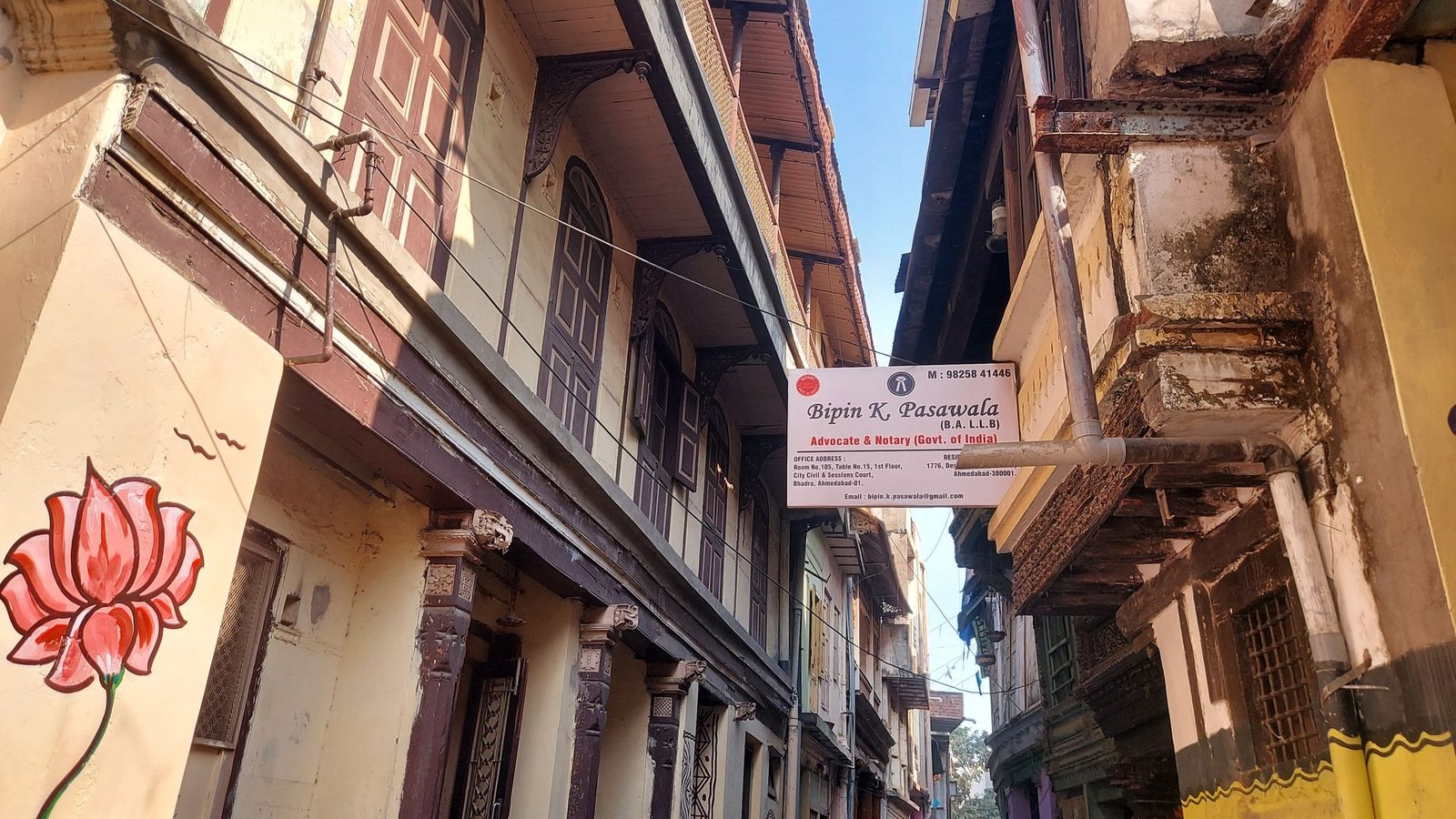
Photo: Riyas16, CC0 (cropped), via Wikimedia Commons

The walled city of Ahmedabad, early on the morning of 2 October, Gandhi’s birthday.
A lane that bends so you cannot see where it ends.
A neighbourhood behind one gate
A pol is a neighbourhood with one gate and many houses. Old Ahmedabad has hundreds of them, each a cluster of narrow lanes once shared by families of the same trade, caste or faith. The houses stand tall and close, with wooden fronts carved with flowers, parrots and figures, worn smooth where hands have touched them for generations. Some pols have hidden passages linking one lane to the next, once useful in a raid or a riot.
Life in the lanes
In the middle of many pols stands a chabutro, a tall painted bird-feeder on a pole, where residents leave grain each morning. Neighbours sit on the raised steps in front of the houses, called otlas, to sort vegetables and talk. Small temples and Jain shrines sit at the corners. At Manek Chowk, the old square, a jewellery market by day becomes a street-food market after dark. On 14 January, for Uttarayan, the kite festival, every rooftop in the pols is full.
Why people come
Ahmedabad was founded in 1411 by Sultan Ahmed Shah. In 2017 its walled city became India’s first UNESCO World Heritage City, for its pols and its stone mosques, including Sidi Saiyyed, whose carved stone window of a tree has become the city’s symbol. Ahmedabad is also where Mahatma Gandhi lived from 1917 to 1930, at Sabarmati Ashram on the river, and where he set out on the Salt March in 1930. On 2 October, Gandhi Jayanti, people gather at the ashram for prayer and spinning.
Getting there
Ahmedabad’s airport has flights from across India and several from the Gulf. Trains from Mumbai take about five to seven hours. The best way into the pols is the heritage walk run by the city every morning at 7.45, starting from the Swaminarayan temple at Kalupur. It takes about two and a half hours and ends near the Jama Masjid.
What to look for in a pol
Look up first. The old houses are built of timber and brick, and the wood carries the decoration: carved brackets, balconies with turned railings, heavy doors studded with metal. UNESCO, in listing the city in 2017, singled out this timber architecture as the most distinctive part of its heritage.
Then look for the parts of the pol itself. The main gate opens from the street. Inside, a khadki, a smaller inner gate, leads to a cluster of houses on a shared lane. The chabutro, the tall bird feeder, stands where the lanes meet, often near a well or a small shrine. On the city’s walk, Shantinath ni Pol shows one of the secret passages that let residents slip from one lane to the next.
A day in the old city
The heritage walk ends at the Jama Masjid, built by Ahmed Shah, close to Manek Chowk. From there it is a short walk to the Bhadra Fort and to the Sidi Saiyyed mosque at Lal Darwaja, with its carved stone window of interlaced trees.
Break for lunch: a Gujarati thali, or dhokla and a glass of chaas from a farsan shop. Spend the afternoon across the river at Sabarmati Ashram. Gandhi’s house, Hriday Kunj, stands near the water; for now it is seen from outside while conservation work goes on. In the evening, go back to Manek Chowk when the food stalls open. With a second day, add the stepwell at Adalaj, half an hour north.
In the pols
- Join the morning heritage walk. The lanes are hard to find your way through alone.
- Speak softly, and ask before photographing people or open doorways. These are homes.
- Visit Sabarmati Ashram in the afternoon. Entry is free.
- Come back to Manek Chowk after nine at night to eat.
Once, the gate at the end of the lane was shut every night. The pol is still a village that happens to sit inside a city.
Plan your visit
| Best season | November to February. Uttarayan, the kite festival, falls on 14 January. Navratri in 2026 runs from 11 to 19 October. |
|---|---|
| How to reach | Sardar Vallabhbhai Patel International Airport has flights across India and abroad. Ahmedabad Junction, at Kalupur, is on the edge of the old city. |
| Getting around | Walk in the pols; most lanes are too narrow for cars. Autos, app cabs and the metro cover the rest of the city. |
| Heritage walk | Daily from 7.45 to 10.30 am, starting at the Swaminarayan temple, Kalupur; report by 7.30. As of October 2026 it costs ₹200 for Indian and ₹300 for foreign citizens, with no refunds. Toll-free line: 1800 233 9008. |
| Sabarmati Ashram | Open every day, 10 am to 6 pm, including public holidays. Entry is free. Personal photographs are allowed, without flash or tripods. |
| Where to stay | Around Relief Road and Lal Darwaja to be close to the walk; Ashram Road, Navrangpura or the riverfront for quieter streets. |
| How long to spend | Two days: one for the walk and the old city, one for the ashram, the stepwell at Adalaj and the museums. |
Questions people ask
What time does the Ahmedabad heritage walk start?
The city’s morning heritage walk starts at 7.45 am every day from the Swaminarayan temple at Kalupur; report by 7.30. It runs until about 10.30 and ends at the Jama Masjid near Manek Chowk.
What should I wear on the heritage walk?
The route passes through a temple and a mosque, so the city asks walkers to cover the shoulders, chest, navel and upper arms, and to wear clothes that reach below the knee. Wear shoes that slip off easily.
Is there an entry fee for Sabarmati Ashram?
No. Entry is free, and the ashram is open from 10 am to 6 pm every day, public holidays included.
When is the Manek Chowk night market open?
Gujarat Tourism lists it from dusk to midnight. The food stalls set up after the jewellery shops close, so it fills from about nine.
Read next
Written by Muthu, editor of Aura of India. Sources: Ahmedabad Municipal Corporation: Heritage Walk, Sabarmati Ashram: Visitor Information, UNESCO World Heritage Centre: Historic City of Ahmadabad, Gujarat Tourism: Manek Chowk. Last verified: 13 October 2026.
Your turn: Have you walked the pols of Ahmedabad? Which lane, gate or carved house stayed with you?
Comments
Post a Comment
Comments are always welcome, that will help us to motivate ourselves and improve our services. Thanks!!