Rani ki Vav and Adalaj: Gujarat’s Stepwells and How to Visit
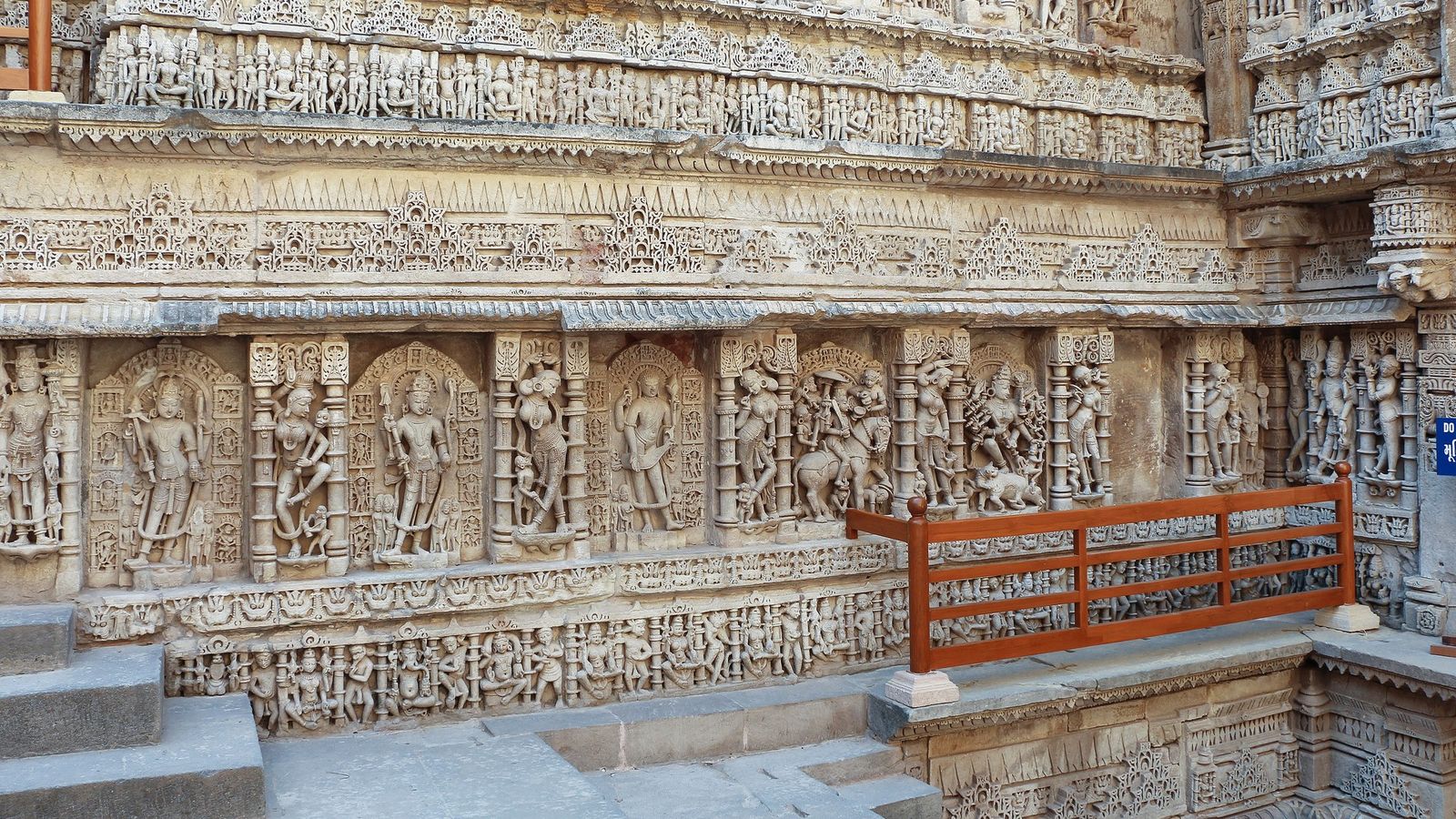
Photo: Bernard Gagnon, CC BY-SA 3.0 (cropped), via Wikimedia Commons

A stepwell in Gujarat, late morning.
A building you enter by going down.
Down into the cool
A stepwell, called a vav in Gujarat, is a well you walk into. Stone steps descend in flights from ground level to the water, with landings and pillared galleries at each level, so the building is upside down: all its architecture lies below the ground. As you go down, the air cools by several degrees and the sky becomes a square of light overhead. The pattern repeats: a landing, a turn, another flight.
What they were for
In a dry land with one short monsoon, stepwells reached the water as it rose and fell through the year. Women came to draw water and rest in the shade, and travellers stopped on the trade routes. The galleries were places of prayer too. The carvings, of goddesses, dancers, flowers and elephants, turned a daily chore into a visit to something beautiful. Many stepwells were built or paid for by women.
Why people come
Gujarat has some of the finest stepwells in India. Adalaj, near Ahmedabad, was built in 1499 and goes down five storeys, carved in a blend of Hindu and Islamic styles. Rani ki Vav, at Patan, is older, from the eleventh century, built in memory of a king and traditionally credited to his queen, Udayamati. It lay buried under river silt for centuries, which saved hundreds of its sculptures. It is a UNESCO World Heritage Site and appears on the hundred-rupee note.
Getting there
Adalaj is about eighteen kilometres north of Ahmedabad, a half-hour drive. Patan is about 125 kilometres away, roughly three hours, and can be combined with the Sun Temple at Modhera on the way. Most visitors go by taxi from Ahmedabad. Rani ki Vav has an entry fee, higher for visitors from abroad.
What to look for at Rani ki Vav
Rani ki Vav is built as an inverted temple, and you walk down into it from the east. It has seven levels of steps and galleries, with more than five hundred main sculptures and over a thousand smaller ones. Most show Vishnu and his avatars, among goddesses, sages, celestial dancers and carved screens.
The fourth level is the deepest open space: a tank about 9.5 metres square, 23 metres below the ground. At the far western end is the well itself, a round shaft ten metres across and thirty metres deep. A chronicle of 1304 says Queen Udayamati built it in 1063 in memory of Bhima I. Floods later filled it with silt; it was rediscovered in the 1940s and restored by the Archaeological Survey of India in the 1980s.
A day trip from Ahmedabad
Leave early and drive north to Modhera, about 99 kilometres from Ahmedabad. Its Sun Temple, built in 1026–27 under the same Bhima I, faces a stepped tank lined with 108 small shrines. Go on to Patan for Rani ki Vav, and stay for lunch in the town, home of patola, the double-ikat silk.
Gujarat Tourism runs a projection show on the walls of Rani ki Vav after dark, at 7.30 and 8 pm. Adalaj, close to Ahmedabad, fits into an afternoon on another day. For the Sun Temple and the other great shrines of the state, see Gujarat’s temples.
On the steps
- Go before noon, when the light reaches down into the well.
- The steps are worn and can be slippery. Watch your footing.
- From the bottom landing, look up. The whole building is above you.
- Rani ki Vav and Modhera fit in one day with an early start.
Climb back up slowly. The heat meets you on the last flight.
Plan your visit
| Entry fee | Rani ki Vav: the ASI lists ₹25 in cash (₹20 online) for Indian, SAARC and BIMSTEC visitors and ₹300 (₹250 online) for other foreign visitors. A fee revision was proposed in September 2026, so check before you go. Adalaj: check at the gate. |
|---|---|
| Opening hours | Rani ki Vav: 8 am to 6 pm, with the projection show at 7.30 and 8 pm. Adalaj: daylight hours; check at the gate. |
| Best time | October to February. Go in the late morning, when sunlight reaches the lower galleries. |
| How to reach | Adalaj is about 18 kilometres north of Ahmedabad, near Gandhinagar. Patan is about 125 kilometres from Ahmedabad; buses take about three and a half hours, a taxi less. |
| Nearest airport and station | Ahmedabad airport for both. Patan has its own railway station; Mehsana junction is the main stop on the line north. |
| Where to stay | Ahmedabad, as a base for day trips; Patan or Mehsana for an early start. |
Questions people ask
What is the entry fee for Rani ki Vav?
The ASI lists ₹25 for Indian, SAARC and BIMSTEC visitors and ₹300 for other foreign visitors, a little less if you book online. A revision was proposed in September 2026, so check at the gate.
What are the timings of Rani ki Vav?
The ASI lists 8 am to 6 pm. Gujarat Tourism also runs a projection show on the stepwell after dark, at 7.30 and 8 pm.
Can you see Rani ki Vav and Modhera in one day?
Yes. Both lie north of Ahmedabad, and with an early start a hired car can cover Modhera, Patan and the drive back in a long day.
How long do you need at a stepwell?
Allow an hour or more at Rani ki Vav to walk all the levels, and less at Adalaj.
Read next
Written by Muthu, editor of Aura of India. Sources: UNESCO World Heritage Centre: Rani-ki-Vav, Gujarat Tourism: Rani ki Vav, Gujarat Tourism: Sun Temple, Modhera. Last verified: 13 October 2026.
Your turn: Have you walked down into Rani ki Vav or Adalaj? Which level did you stop on longest?
Comments
Post a Comment
Comments are always welcome, that will help us to motivate ourselves and improve our services. Thanks!!