Crawford Market, Mumbai: Timings, What to Buy and History
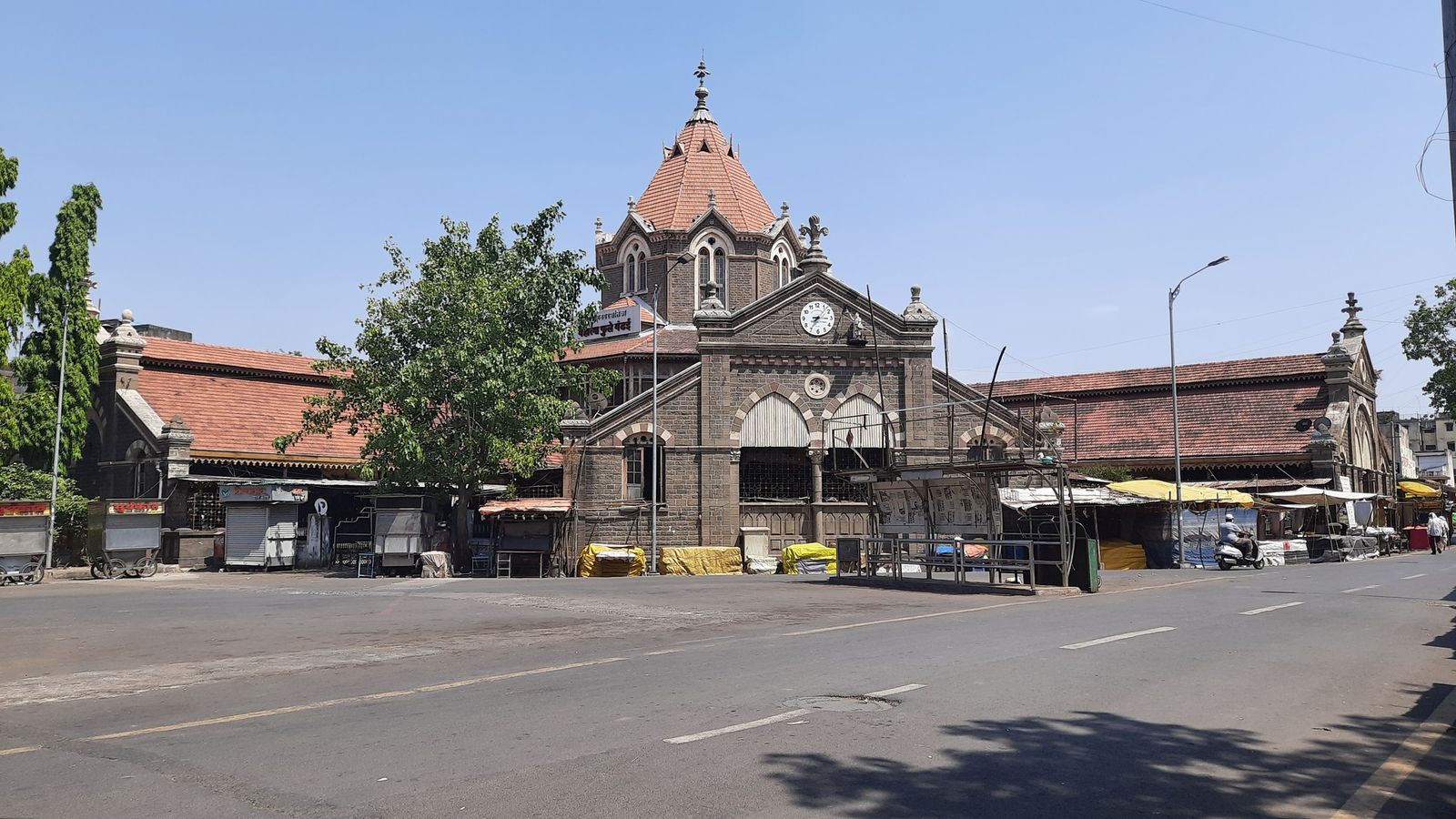
Photo: Saarang Rajguru (सारंग राजगुरू), CC BY-SA 4.0 (cropped), via Wikimedia Commons

Crawford Market, Mumbai, on a weekday morning.
A Victorian market hall where Mumbai still comes to buy its fruit.
A clock tower over the fruit
Crawford Market stands at the northern edge of the old Fort area, a short walk from CSMT station. Its official name is Mahatma Jyotiba Phule Mandai; mandai means market. The building is pale stone banded with red, with arched gateways and a clock tower 128 feet high. Inside, an iron roof covers long halls of stalls. Fruit takes one wing and vegetables the other. Around them are shops for dry fruit, spices, tea, imported chocolates, kitchenware and pets.
How Mumbai shops here
Fruit arrives early, and by late morning the stalls are stacked high: oranges, pomegranates, guavas, bananas, and crates of whatever is in season. In April and May the market is given over to Alphonso mangoes, called hapus here, from Ratnagiri and Devgad on the Konkan coast. Home cooks come for the day’s fruit, small restaurants for boxes, and families before a festival for dry fruit to give as gifts. The light inside is dimmer than the street, and the colour of the fruit does the work.
Built in 1869
The market is named after Arthur Crawford, Bombay’s first municipal commissioner. The architect William Emerson, who later designed the Victoria Memorial in Kolkata, drew it in a Gothic style, and it opened in 1869. Over the entrance are stone panels by John Lockwood Kipling, father of the writer Rudyard Kipling, who taught at the art school nearby. One shows farmers at a well, the other traders bringing in fruit. Kipling also designed the carvings on the fountain in the courtyard, finished in 1874. Rudyard, born in Bombay in 1865, later remembered early-morning walks to the fruit market.
How to get there
The market is on Lokmanya Tilak Marg, about ten minutes on foot from CSMT, where the Central and Harbour local lines end. The Aqua Line metro stops at CSMT and Kalbadevi, each a short walk away. Come in the late morning on a weekday, when the stalls are full. Many shops close on Sunday or open only in the morning.
The carvings and the fountain
The main entrance has three arches. Over two of them are half-moon panels of white marble, designed by Kipling, who was then at the Sir J. J. School of Art, a short walk north. One is a well scene: people gathered with water pots, oxen, a goat and a man planting. The other shows trade: a porter with a basket of pineapples and bananas, buyers and sellers bargaining, and a bullock cart loaded with melons. A Bombay building journal of 1869 praised the carving as one of the largest pieces of its kind yet attempted in India.
The fountain stands in the open court that was once the market garden. It was a gift of the merchant Cowasji Jehangir, and its stone is carved with Indian river goddesses and birds. For years it was hidden behind crates and stalls. Between 2015 and 2018 the city corporation restored the main hall and the clock tower, with the conservation architect Abha Narain Lambah, and the fountain was restored as part of the work. The rest of the site is still being rebuilt, with new blocks for the fish and mutton sellers, so expect hoardings and detours around the edges.
The market was the city’s main wholesale fruit market until 1996, when the wholesale trade moved to Navi Mumbai. What remains is a retail market, still the place many Mumbai families go for good fruit.
Mohammed Ali Road, next door
North of the market, Mohammed Ali Road runs under the long JJ flyover into the old neighbourhoods of Pydhonie and Bhendi Bazaar. About a kilometre up is Minara Masjid, a mosque of the Memon trading community, and the lanes around it are known across the city for food: kebabs, nalli nihari (slow-cooked mutton shank), malpua (sweet fried pancakes) and phirni, a set rice pudding.
During Ramzan, the month of fasting, the lanes fill with stalls after sunset and stay crowded late into the night. Ramzan follows the moon and comes about eleven days earlier each year, so check the dates. In other months the eating houses are quieter but many stay open.
Emerson’s other great building is the Victoria Memorial in Kolkata, and New Market there is a covered market of the same age. In Mumbai, the Gateway of India and the harbour are a short taxi ride south. For the rest of the state, see the Maharashtra guide.
Before you go
- Most shops open in the late morning. Hours vary, so check locally.
- Ask the rate per kilo or per dozen before the fruit is weighed.
- Look up at the entrance arches. Kipling’s panels are easy to miss.
- Buy fruit you will eat the same day. A heavy bag is hard work on a crowded local train.
Outside, the clock keeps the time for the street. Inside, the fruit tells you the month.
Plan your visit
| Opening hours | Most shops open in the late morning and close in the evening; fruit stalls start earlier. Hours are not published officially and vary by shop, so check locally. |
|---|---|
| Closed on | Many shops close on Sunday or trade only in the morning. Some stalls also take another weekly day off. Check before you go. |
| How to reach | About ten minutes on foot from CSMT station; Masjid station is a little closer. Aqua Line metro: CSMT or Kalbadevi. Taxis drop at the main gate on Lokmanya Tilak Marg. |
| What to buy | Seasonal fruit, Alphonso mangoes in April and May, dry fruit, spices, tea, imported chocolates and steel kitchenware. |
| Bargaining | Ask the rate per kilo or per dozen first. Polite bargaining is usual on larger amounts at the open stalls; packaged goods have printed prices. |
| Time needed | An hour for the market. Add an hour or two for Mohammed Ali Road. |
Open Crawford Market, Mahatma Jyotiba Phule Mandai, Lokmanya Tilak Marg, Mumbai in Google Maps
Questions people ask
What is Crawford Market’s official name?
Mahatma Jyotiba Phule Mandai, after the nineteenth-century social reformer of Maharashtra. Most people in Mumbai still call it Crawford Market.
Is Crawford Market open on Sunday?
Partly. Many shops close on Sunday or open only in the morning, and hours vary from stall to stall. Visit on a weekday if you can, and check locally.
Who made the carvings at Crawford Market?
John Lockwood Kipling, the father of Rudyard Kipling, designed the marble panels over the entrance and the carving of the fountain inside. He taught at the Sir J. J. School of Art nearby.
When can I buy Alphonso mangoes at Crawford Market?
In April and May, the main season for Alphonso mangoes from Ratnagiri and Devgad. The first boxes can appear earlier, at higher prices.
How far is Mohammed Ali Road from Crawford Market?
It begins beside the market. Minara Masjid and its food lanes are about a kilometre north, a walk of ten to fifteen minutes.
Read next
Written by Muthu, editor of Aura of India. Sources: Maharashtra State Gazetteers, Greater Bombay District: Places (Mahatma Jyotiba Phule Market), Brihanmumbai Municipal Corporation: List of municipal markets, Incredible India: Mumbai (Crawford Market and Mohammed Ali Road), Minara Masjid Trust Estate: About, The Indian Express: Reinventing Crawford. Last verified: 14 October 2026.
Your turn: Which stall at Crawford Market do you go back to, and what do you buy there?
Comments
Post a Comment
Comments are always welcome, that will help us to motivate ourselves and improve our services. Thanks!!