Konark Sun Temple: Entry Fee, Timings and How to Visit
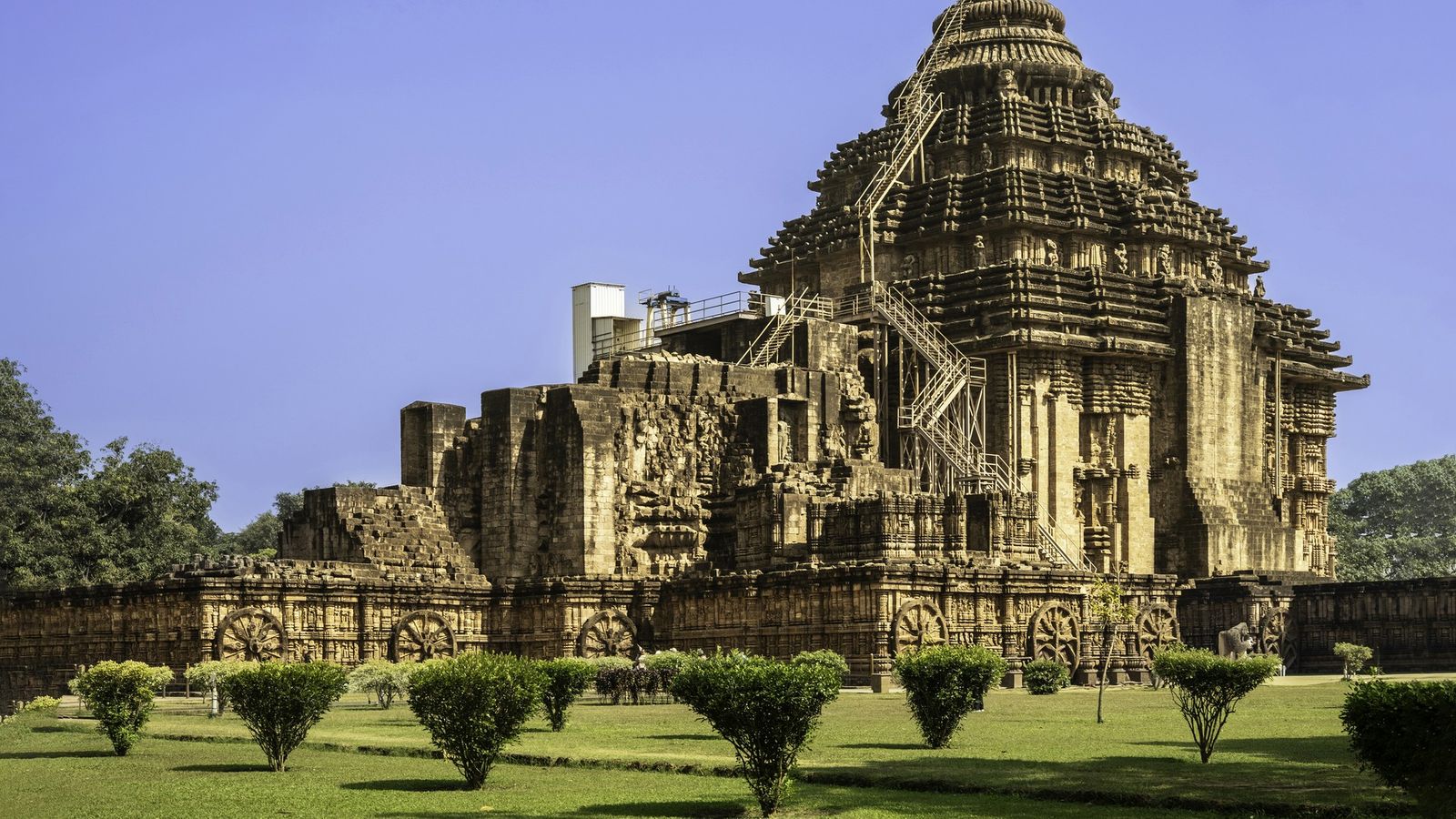
Photo: Joydeep Chakraborty, CC BY-SA 4.0 (cropped), via Wikimedia Commons

The Sun Temple at Konark, in the early morning.
A temple built as a chariot for the sun.
A chariot of stone
The Sun Temple at Konark was built as the chariot of Surya, the sun god: a stone platform on twenty-four great carved wheels, drawn by seven stone horses. Each wheel is about three metres across, its spokes and rim covered in fine carving. The tall main tower fell long ago. What stands today is the great hall in front of it, a stepped pyramid of stone still nearly forty metres high.
What the walls hold
Every surface is carved: dancers and musicians, elephants, hunts, court scenes, mythical creatures and, famously, loving couples. The wheels are said to work as sundials, telling the time by the shadow of the spokes. The sanctum is empty and the temple is no longer in worship, which is why it is open to everyone.
Why people come
Konark was built around 1250 by Narasimhadeva I, a king of the Eastern Ganga dynasty. European sailors used its dark tower as a landmark and called it the Black Pagoda. It is a UNESCO World Heritage Site, and one of its wheels appears on the ten-rupee note. Every December the Konark dance festival is held against its walls, with India’s classical dancers performing under the stone.
Getting there
Konark is about 35 kilometres from Puri along the coastal Marine Drive, and about 65 kilometres from Bhubaneswar. Buses and shared autos run from Puri, but most visitors take a taxi. Tickets are sold at the gate and online, and cost less for Indian and South Asian visitors. Chandrabhaga beach is three kilometres away.
Reading the stone
Walk the platform slowly. Twelve pairs of wheels run along its sides, each spoke and rim covered in carving, and seven horses pull the chariot forward. On the outer walls of the sanctum, three large images of Surya stand in niches. The roof of the great hall, the jagamohana, rises in three tiers, set with life-size female figures that the ASI calls of matchless charm.
In front of the hall stands the separate nata mandira, the dance hall, now open to the sky. To the west are the remains of an earlier shrine, the Mayadevi temple, of the late eleventh century, and a small brick Vaishnava temple found under the sand in 1956. Fallen sculptures are kept in the ASI’s Archaeological Museum at Konark.
The sealed hall
In the early 1900s British engineers filled the jagamohana with sand to stop it from collapsing, and sealed it. It has been closed ever since; visitors see it only from outside.
In 2026 the ASI began cutting a passage, six feet by five, into the western wall to take the sand out by hand, with a working platform on that side. The work is slow, so expect scaffolding at the back of the hall. The rest of the temple remains open. Pair the visit with a morning in Puri, or see the Odisha guide.
At the temple
- Go at opening, around six. The morning sun lights the eastern side.
- Hire a licensed guide at the gate. The carvings are easier to read with one.
- Walk around the temple once, then step back to see the chariot whole.
- The museum near the site holds sculptures that fell from the tower.
From the road, the wheels, the horses and the hall read as one shape. Up close, they break into carving again.
Plan your visit
| Entry fee | As of October 2026 (ASI): ₹40 in cash or ₹35 online for Indian, SAARC and BIMSTEC visitors; ₹600 in cash or ₹550 online for other foreign visitors. Children under 15 enter free. |
|---|---|
| Opening hours | Sunrise to sunset. |
| Best time | October to February. Come at opening for the early light on the east side. The Konark Festival runs from 1 to 5 December, 6 to 8.30 pm, with tickets at ₹100. |
| How to reach | About 35 kilometres from Puri along the coast road, and about 65 kilometres from Bhubaneswar. Buses run from Puri and Bhubaneswar; most visitors take a taxi. |
| Nearest airport and station | Bhubaneswar airport, about 65 kilometres. Railway stations: Puri and Bhubaneswar. |
| Where to stay | Puri, for most visitors; Konark itself for sunrise at the temple; Bhubaneswar for a day trip. |
| Dress and rules | The temple is not in worship, so visitors of all faiths may enter. Stay off the carvings and the wheels. |
Questions people ask
What is the entry fee for the Konark Sun Temple?
As of October 2026 the ASI charges ₹40 in cash (₹35 online) for Indian, SAARC and BIMSTEC visitors, and ₹600 (₹550 online) for other foreign visitors. Children under 15 are free.
What are the Konark Sun Temple timings?
The ASI lists the temple as open from sunrise to sunset. Arrive early for cooler air and the light on the eastern face.
Can non-Hindus visit Konark?
Yes. The temple is no longer in worship and is a protected monument, so visitors of every faith can enter with a ticket.
Is the inside of the Konark temple open?
No. The great hall has been filled with sand and sealed since the early 1900s. The ASI began work in 2026 to remove the sand, but visitors still see the temple only from outside.
Read next
Written by Muthu, editor of Aura of India. Sources: Archaeological Survey of India: Sun Temple, Konarak, Odisha Tourism: Konark Festival, Hindustan Times: ASI starts sand removal at Konark’s Jagamohan (April 2026). Last verified: 13 October 2026.
Your turn: Did you see Konark at opening time or late in the day? Which carving made you stop?
Comments
Post a Comment
Comments are always welcome, that will help us to motivate ourselves and improve our services. Thanks!!