Odisha's Golden Triangle: Bhubaneswar, Puri and Konark
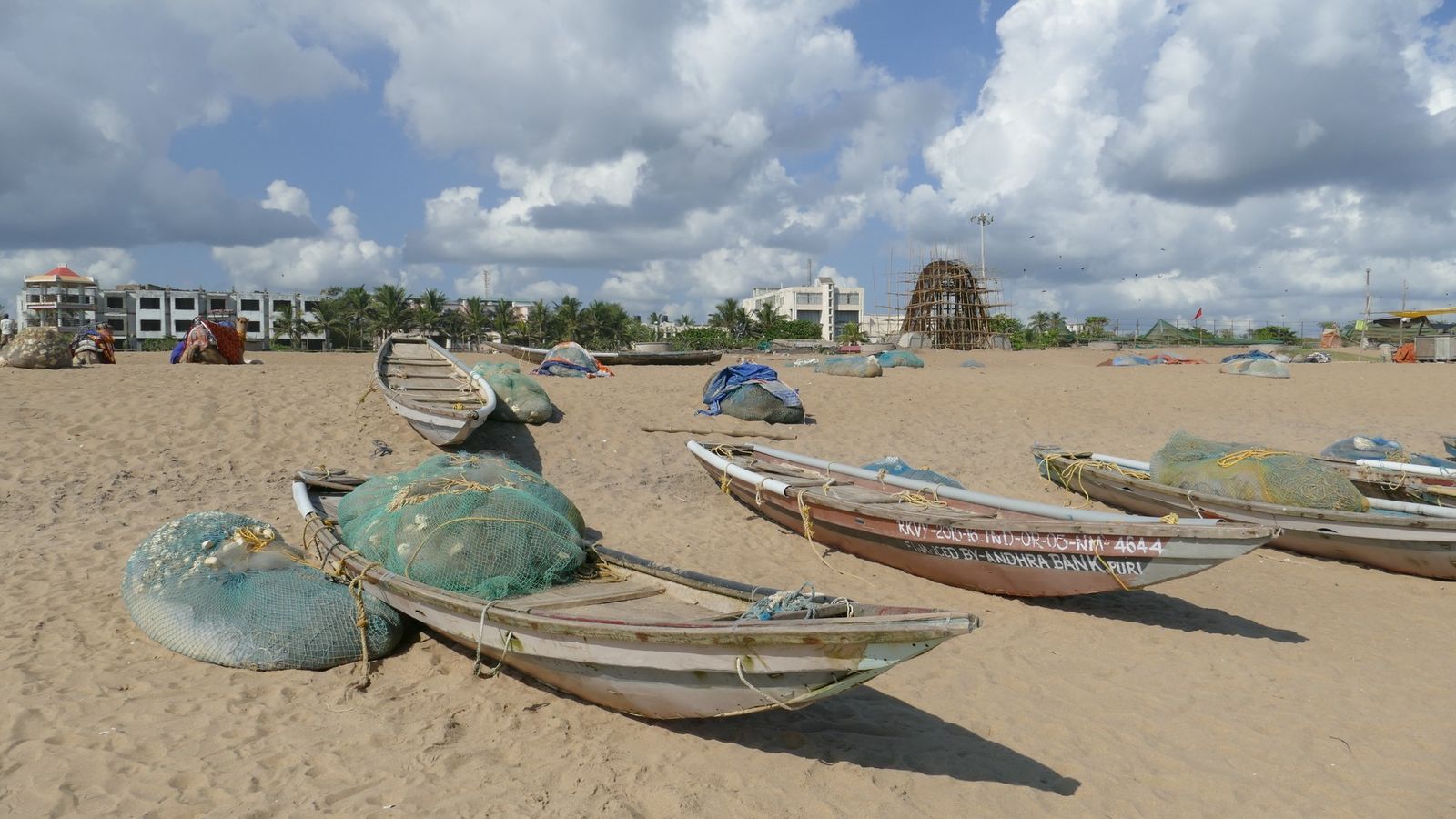
Photo: Kritzolina, CC BY-SA 4.0 (cropped), via Wikimedia Commons

The Odisha coast, from Puri to Konark, in the morning.
The temples sit on the coast as if the sea were part of the plan.
A triangle of temples
Odisha lies on India’s east coast, south of Bengal, and its heart is a triangle of three towns about an hour apart. Bhubaneswar, the capital, is called the temple city, with hundreds of old temples among its modern streets. Puri, on the sea, is one of Hinduism’s great pilgrim towns. Konark, up the coast, has the Sun Temple, a ruin shaped like a chariot. Behind the coast lies Chilika, a vast lagoon of mixed sea and river water.
How the state lives
Odisha’s temples have their own style: tall curved towers called deuls, carved all over. Around them live the crafts. In Raghurajpur, near Puri, almost every house is a studio for pattachitra, fine painting on cloth and palm leaf. Pipili makes bright appliqué. Odissi, one of India’s classical dances, grew up in the temples here. The food is gentle and rice-based: dalma, lentils cooked with vegetables, and on hot days pakhala, rice soaked in water.
Why people come
For pilgrims, Puri is one of the char dham, the four sacred abodes, and its Rath Yatra, when the deities ride huge wooden chariots through the town each June or July, draws more than a million people. For visitors from abroad, Konark, a UNESCO World Heritage Site, is the headline, along with a coast still far less crowded than Goa or Kerala. Odisha calls itself India’s best-kept secret, and it is not far wrong.
How to cross it
Bhubaneswar’s airport has flights from across India, but few from abroad, so most visitors from overseas connect through Kolkata, Delhi or Mumbai. Trains reach Bhubaneswar and Puri from Kolkata overnight, or in five to nine hours by day. Puri is about 60 kilometres from Bhubaneswar, and Konark about 35 kilometres from Puri along a coastal road called the Marine Drive. A hired car can do the triangle in one long day, but three days is better.
Three days on the triangle
Day one, Bhubaneswar. Start among the old temples around the Bindu Sagar tank, where the small Mukteswar and the Rajarani show the Odia style at its most delicate. The Lingaraj temple admits Hindus only, but a raised platform outside its north wall gives a clear view of the tower. In the afternoon, climb to the Jain caves of Udayagiri and Khandagiri on the edge of the city.
Day two, the road to Puri. Stop at Pipili for appliqué and at Raghurajpur, where families paint pattachitra and engrave palm leaves, and reach Puri by evening for the beach. Day three, leave at dawn for the Sun Temple at Konark, then follow the coast road back.
Chilika, the lagoon behind the coast
South of Puri, Chilika is a shallow lagoon where the sea and the rivers mix, more than sixty kilometres long. In 1981 it became one of India’s first wetlands listed under the Ramsar Convention. Boats from Satapada go out to look for Irrawaddy dolphins, and in winter the marshes fill with migrating birds.
Chilika adds a day to the triangle and is easiest from Puri. Go early, when the water is calm.
Before you go
- October to February is the season. Summer is hot and humid.
- The Jagannath temple in Puri and the Lingaraj temple in Bhubaneswar are open to Hindus only.
- Konark is open to everyone.
- The Konark dance festival, in early December, is held in front of the Sun Temple.
Between Konark and Puri the road follows the sea. Drive it once in the morning light.
Plan your visit
| Best season | October to March. The Konark Festival of classical dance runs from 1 to 5 December every year. Rath Yatra in Puri, in June or July, brings very large crowds. |
|---|---|
| How to reach | Fly to Bhubaneswar. Trains from Kolkata, Delhi, Chennai and other cities reach Bhubaneswar and Puri; the Howrah–Puri Vande Bharat Express takes under seven hours. |
| Getting around | A hired car is easiest for the triangle. Buses and shared autos link Bhubaneswar, Puri and Konark. |
| Where to stay | Old Town or Saheed Nagar in Bhubaneswar; the beach road or near the Grand Road in Puri; Konark for a quiet sunrise. |
| How long to spend | Three days for Bhubaneswar, Puri and Konark; five with Chilika and the craft villages. |
| Temple entry | The Jagannath temple in Puri and the Lingaraj temple in Bhubaneswar admit Hindus only. Others can look in from the roof of the Emar Matha in Puri and the platform by Lingaraj’s north wall. Konark is open to all. |
Questions people ask
Can non-Hindus enter the Jagannath temple in Puri?
No. The temple admits Hindus only. Visitors of other faiths can see into the enclosure from the roof of the Emar Matha, near the eastern gate.
How many days do you need for Bhubaneswar, Puri and Konark?
A hired car can do the triangle in one long day, but three days lets you see each place in the morning light. Add a day for Chilika.
What is the best time to visit Odisha?
October to March, when it is cooler and drier. The Puri temple administration recommends the same months.
When is the Konark Dance Festival?
From 1 to 5 December every year, in the open-air auditorium near the Sun Temple, from 6 to 8.30 pm. Odisha Tourism lists entry at ₹100.
Read next
Written by Muthu, editor of Aura of India. Sources: Odisha Tourism: Konark Festival, Shree Jagannatha Temple Administration: Puri at a Glance, The New Indian Express: international flights from Bhubaneswar. Last verified: 13 October 2026.
Your turn: Which corner of Odisha’s triangle held you longest: Bhubaneswar’s temples, Puri’s beach or Konark’s wheels?
Comments
Post a Comment
Comments are always welcome, that will help us to motivate ourselves and improve our services. Thanks!!