Navratri 2026: Dates, Meaning and Where to See the Festival
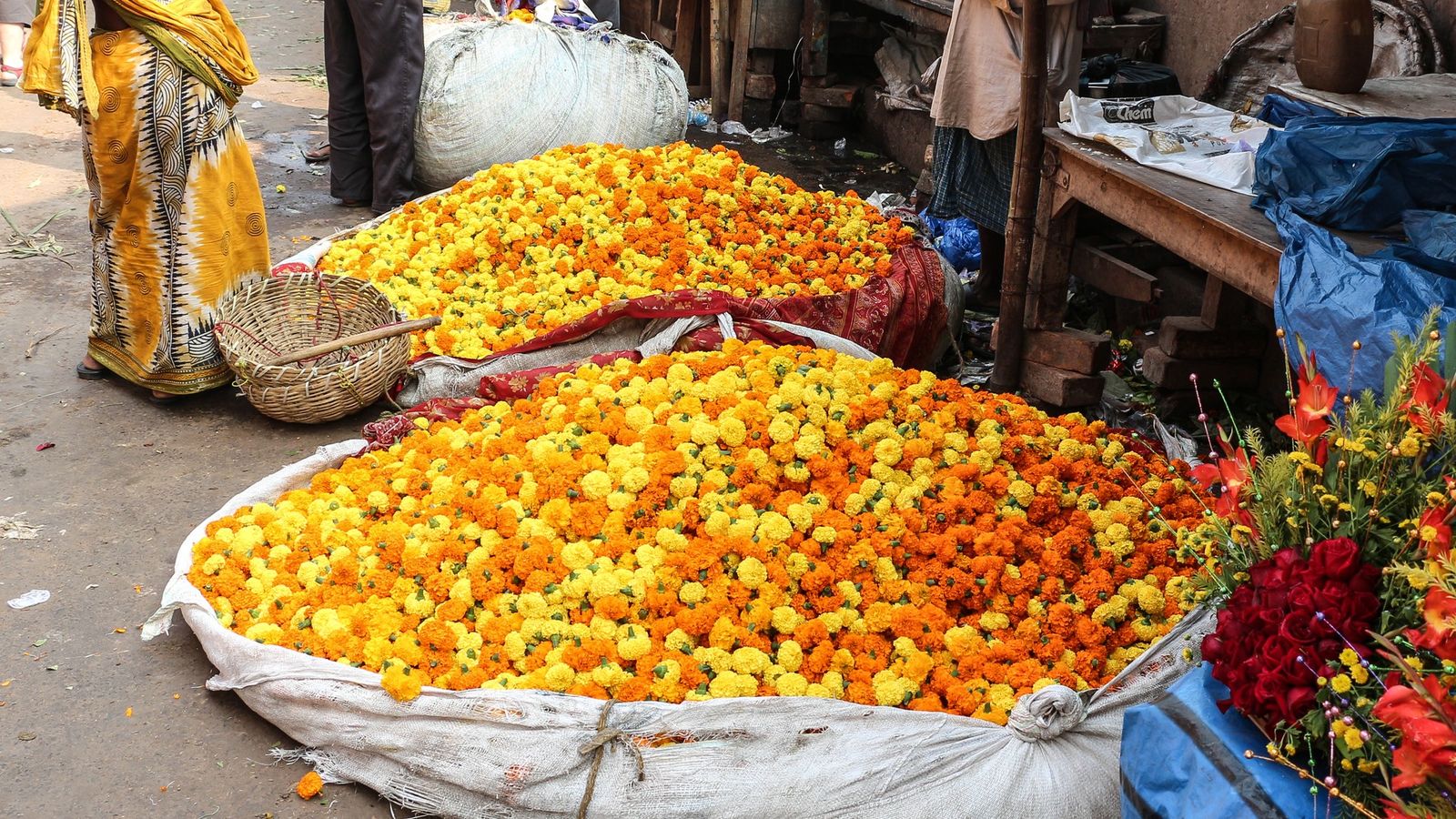
Photo: Bernard Gagnon, CC BY-SA 3.0 (cropped), via Wikimedia Commons

A flower market in the middle of Navratri, early morning.
Nine nights, and a different festival in every state.
Marigolds by the armful
Before the shops open, the flower sellers are already at work. Marigolds come in by the sackful, orange and yellow, and are strung into long garlands on the pavement. Mango leaves are tied into door hangings. Small clay lamps are stacked in towers beside coconuts, red cloth and packets of puffed rice. By nine the garlands are gone, carried home on scooters and hung over doorways and shrines.
Nine nights for the goddess
Navratri means nine nights. They are kept for the goddess Durga, worshipped in a different form each day. Many families begin by setting a clay pot of water in the home shrine and sowing grain beside it. By the ninth day the shoots stand several inches tall. Many people fast through the week, eating fruit, milk and dishes made from sago or buckwheat flour instead of grain. In 2026 the nine nights run from 11 to 19 October, and regional calendars can shift a date by a day.
The same week, told differently
Each region keeps the festival in its own way. Gujarat dances garba in great circles every night. Bengal builds pandals for Durga Puja, which reaches its peak from 18 to 21 October. In Tamil Nadu and Karnataka, families set out golu, steps of dolls arranged in the front room, and visit each other with sweets. In the north, the story of Rama is staged night after night in the Ramlila, which ends with the burning of Ravana on Dussehra, the tenth day.
Where to see it
Any city flower market at dawn is the simplest way in. In Delhi, try the market at Ghazipur. In Mumbai, Dadar. In Kolkata, the Mullick Ghat market under the Howrah Bridge. For the nights, go to Ahmedabad or Vadodara for garba, Kolkata for the pandals, and Mysuru for its Dasara, which ends with a procession on 21 October. Trains and flights sell out around the tenth day, so book early.
The nine nights, one goddess at a time
Each night belongs to one form of Durga. The usual order is Shailaputri, daughter of the mountain, on the first day, then Brahmacharini, Chandraghanta, Kushmanda, Skandamata, Katyayani, Kalaratri, Mahagauri and, on the ninth, Siddhidatri. Many families light a lamp that is kept burning through all nine days.
The eighth and ninth days, Ashtami and Navami, carry the most weight. On one of them many homes hold kanya puja: young girls are invited in, their feet are washed, and they are fed as the goddess herself. In 2026 the lunar days fall tightly. Ashtami is on 19 October, and Navami ends around midday on 20 October, the same day as Dussehra in north India. Bengal and Mysuru keep Vijayadashami, the tenth day, on 21 October.
Bengal counts the festival differently again. There the goddess is said to come home to her parents for a few days, and the public festival runs from Shashthi on 16 October to Bijoya Dashami on 21 October. For the nights among the pandals, read Ashtami night in Kolkata.
A first morning at Mullick Ghat
The flower market in the photograph sits on the Kolkata bank of the Hooghly, under the eastern end of the Howrah Bridge. It has traded here since 1855, and it is one of the largest flower markets in India. Farmers bring marigolds, tuberoses, lotuses and hibiscus in from the countryside, and the wholesale trade is at its height between first light and about nine.
Come by taxi, or walk across the bridge from Howrah station and take the steps down at the Kolkata end. The ground is wet and littered with petals and stems, so wear closed shoes. The sellers are working, so keep to the edges of the lanes and step aside for the porters with baskets on their heads. Once the light is up, walk to the river steps beside the market to see the bridge from below. Kolkata at dawn covers the rest of the riverfront.
Before you go
- Many restaurants serve a special fasting thali this week. It is a good way to taste the food.
- Temples are busiest in the evenings and on the eighth and ninth days.
- Dress modestly, and cover your head where others do.
- Ask before you photograph a home shrine. It is a private room.
By evening the garlands are hanging in a thousand doorways. The market sweeps up and starts again before dawn.
Plan your visit
| 2026 dates | Navratri 11 to 19 October. Dussehra 20 October in north India. Durga Puja in Bengal 16 to 21 October; Mysuru's Jamboo Savari procession on 21 October. Regional calendars can shift a date by a day. |
|---|---|
| Where to see it | Ahmedabad or Vadodara for garba, Kolkata for the pandals, Mysuru for Dasara, Delhi and Varanasi for Ramlila, Chennai and Bengaluru for golu in homes and temples. |
| Dawn flower markets | Mullick Ghat, Kolkata; Dadar, Mumbai; Ghazipur, Delhi. Go between 5 and 8 am, before the wholesale trade winds down. |
| What to wear and bring | Covered shoulders and knees, closed shoes for the markets, and a scarf to cover your head in temples where others do. Carry small notes and a water bottle. |
| Getting there and around | Book trains and flights early around Dussehra and Bijoya Dashami. In Kolkata, Metro hours are usually extended for the puja days; check the schedule before you go. In Mysuru, expect road closures around the palace on procession day. |
| Food | Many restaurants serve a fasting thali this week, made with sago, buckwheat flour, potatoes and milk instead of grain. |
Open Mullick Ghat Flower Market, Kolkata, West Bengal in Google Maps
Questions people ask
When is Navratri in 2026?
Navratri begins on 11 October and the ninth night is 19 October. Dussehra follows on 20 October in north India, while Bengal's Bijoya Dashami and Mysuru's Dasara procession fall on 21 October.
Is Navratri the same as Durga Puja?
They fall in the same fortnight and honour the same goddess. Navratri is the nine-night festival kept across India; Durga Puja is Bengal's form of it, focused on the last five days, with clay images in public pandals.
What do people eat during the Navratri fast?
Fasting food avoids grains, onion and garlic. Common dishes are sabudana khichdi (sago with peanuts), kuttu puri made from buckwheat flour, potatoes, fruit, milk and yoghurt.
Can visitors join garba?
Yes. Large garba grounds in Gujarat usually sell entry passes and expect traditional dress, and smaller neighbourhood circles welcome guests who come with a local. See a garba ground before it fills.
Read next
Written by Muthu, editor of Aura of India. Sources: Drik Panchang: 2026 Durga Puja calendar for Kolkata, Mysuru Dasara 2026: official site and programme, Howrah District, Government of West Bengal: Mullick Ghat Flower Market. Last verified: 13 October 2026.
Your turn: Which flower market do you visit during Navratri, and what do you bring home from it?
Comments
Post a Comment
Comments are always welcome, that will help us to motivate ourselves and improve our services. Thanks!!