Somnath Temple: Aarti Timings, Rules and How to Get There
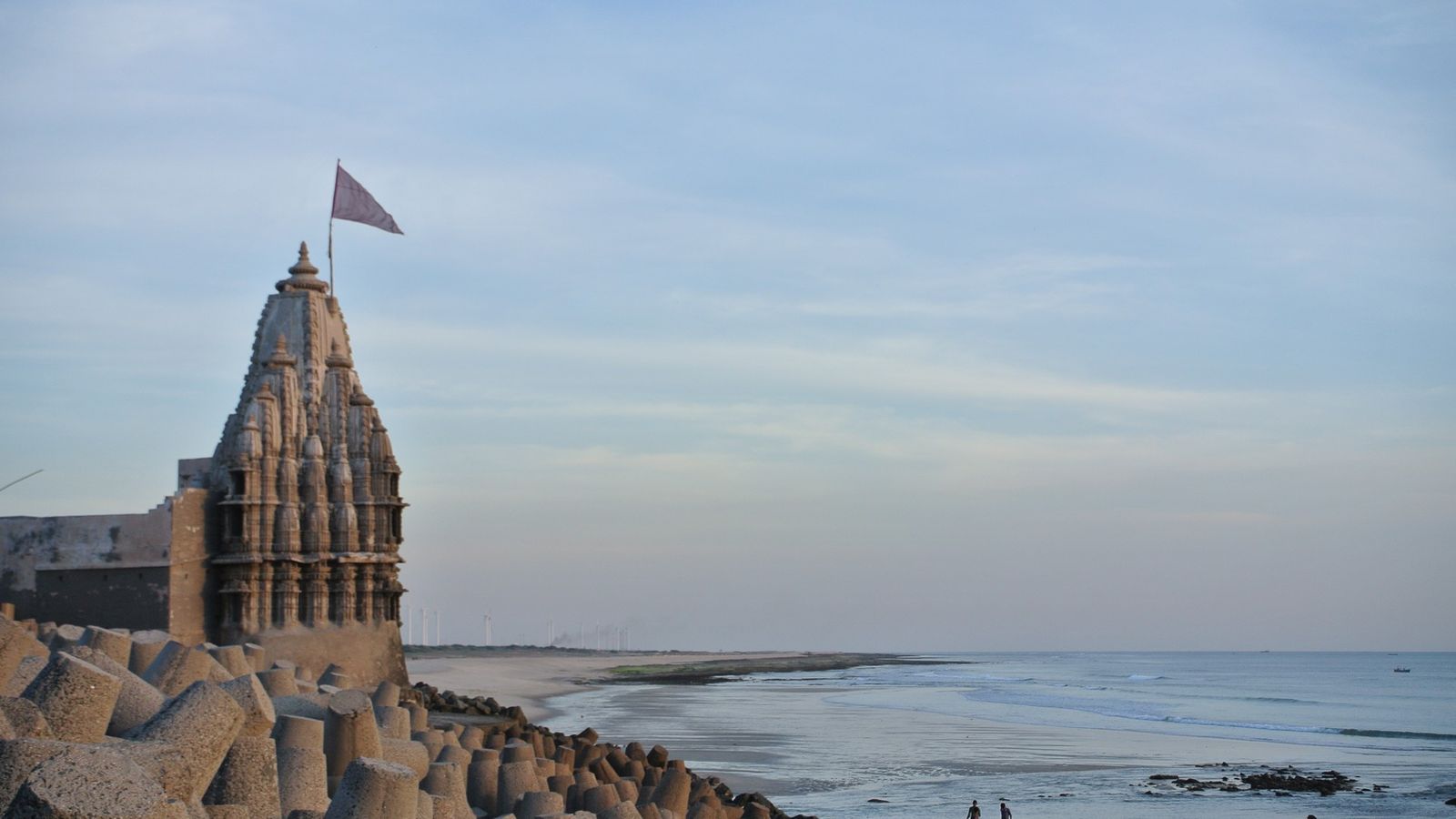
Photo: Sneha G Gupta, CC BY-SA 4.0 (cropped), via Wikimedia Commons

The Somnath temple on the Gujarat coast, at sunset.
A temple rebuilt many times, beside a sea that never needed to be.
A temple on the shore
Somnath stands at the edge of the Arabian Sea near Veraval, on Gujarat’s south coast, and the waves break against the sea wall just below it. It is a temple of Shiva and the first of the twelve jyotirlingas, the holiest shrines where Shiva is worshipped as a column of light. Its pale stone tower rises over the shore and can be seen from far down the beach.
What happens there
Pilgrims come from across India, often on a long journey that takes in several shrines. The aarti, a prayer with lamps and bells, is held at dawn, at noon and in the evening. After dark a sound-and-light show about the temple’s history plays against its walls. On the sea wall stands the Baan Stambh, the arrow pillar, whose inscription says there is no land in a straight line from this point to the South Pole.
Why it matters
Somnath was famously rich, and it was attacked and destroyed many times, most notoriously by Mahmud of Ghazni in 1026, and rebuilt each time. The present temple was built after independence and opened in 1951. For many Indians it stands for survival and return. For a visitor from abroad, it is a way into how history is felt in India: not only studied, but still argued over, and rebuilt.
Getting there
Somnath has its own railway station, about half a kilometre from the temple, and Veraval junction is about seven kilometres away, with trains from Ahmedabad and Rajkot. The nearest airports are Diu, about 85 kilometres east, and Rajkot, about four hours by road. Many visitors combine Somnath with Diu’s beaches, or with Sasan Gir, about 65 kilometres inland, once the park reopens in October.
A history in rebuildings
Tradition says the Moon god built the first temple here, in gold, after Shiva lifted a curse from him; Somnath means lord of the moon. Ravana is said to have rebuilt it in silver and Krishna in sandalwood. The trust that runs the temple keeps those stories alongside the record of raids and rebuildings over many centuries.
The modern temple began with Sardar Patel, who visited the ruins on 13 November 1947 and resolved to raise it again. President Rajendra Prasad consecrated the new shrine on 11 May 1951. Close by stands the smaller temple built in 1782 by Ahilyabai Holkar, the queen of Indore, which kept worship going while the main temple lay in ruins.
Around Somnath
Several sacred sites lie within a few kilometres. At Triveni Sangam three rivers meet the sea. Bhalka Tirth marks the place where Krishna is said to have been struck by a hunter’s arrow. Vallabhghat, beside the temple, is the trust’s chosen sunset point.
The temple trust runs a Tirth Darshan bus to the nearby temples, leaving at 8.30 am and 3.30 pm. For the wider region, see Gujarat’s other great temples and the Gujarat guide.
At the temple
- Phones, cameras and bags are not allowed inside. There are lockers at the entrance.
- Come for the evening aarti and stay for the light show.
- Photograph the temple from the beach or the promenade.
- The sea here is rough. It is not safe for swimming.
Stand on the sea wall at dusk. The temple behind you is new. The sea in front of you is the part that was always there.
Plan your visit
| Entry fee | Free. The light-and-sound show is ticketed; check the price at the temple. |
|---|---|
| Opening hours | Darshan 6 am to 10 pm. Aarti at 7 am, noon and 7 pm. The light-and-sound show runs for an hour from about 8 pm, except in the monsoon. |
| Best time | October to March. Arrive before the 7 pm aarti and stay for the show. Shravan, Mahashivratri and the five-day Kartik Purnima fair draw the largest crowds. |
| How to reach | Somnath is at Prabhas Patan on the Saurashtra coast, about 390 kilometres from Ahmedabad. Trains run from Ahmedabad and Rajkot; most visitors come by train or hired car. |
| Nearest airport and station | Somnath station is half a kilometre from the temple, Veraval junction seven kilometres. Airports: Diu, 85 kilometres; Rajkot, 200 kilometres. Keshod is closer but has few flights; check before you go. |
| Where to stay | Prabhas Patan, around the temple, including the trust’s own guest houses, bookable on somnath.org; Veraval for more choice. |
| Dress and rules | Modest dress; mini skirts are not allowed. Shoes off at the free shoe stand. Phones, cameras, smartwatches and bags go into the free cloakroom. No photography inside. |
Questions people ask
What are the aarti timings at Somnath?
Aarti is held at 7 am, 12 noon and 7 pm. The temple is open for darshan from 6 am to 10 pm.
Are mobile phones allowed inside Somnath temple?
No. Phones, cameras, smartwatches and other electronics go into the cloakroom at the entrance, which is free. Photography is not allowed inside.
Is there a dress code at Somnath?
Saris, dhotis, trousers, shirts and skirts are fine. The trust asks visitors to avoid mini skirts and disrespectful clothing, and to remove footwear before entering.
Can non-Hindus visit Somnath temple?
Yes, but the trust has asked non-Hindu visitors to register at its office before entering. Carry photo ID and check the current procedure at the gate.
How long does a visit to Somnath take?
Allow two to three hours in the evening for darshan, the 7 pm aarti and the light-and-sound show, with time on the promenade.
Read next
Written by Muthu, editor of Aura of India. Sources: Shree Somnath Trust: FAQ, Shree Somnath Trust: Somnath Darshan, Gujarat Forest Department: Gir permit booking. Last verified: 13 October 2026.
Your turn: Have you watched the evening aarti at Somnath with the sea behind the temple? Did you stay on for the light show?
Comments
Post a Comment
Comments are always welcome, that will help us to motivate ourselves and improve our services. Thanks!!