Bandhani of Kutch: How It’s Made and Where to Buy
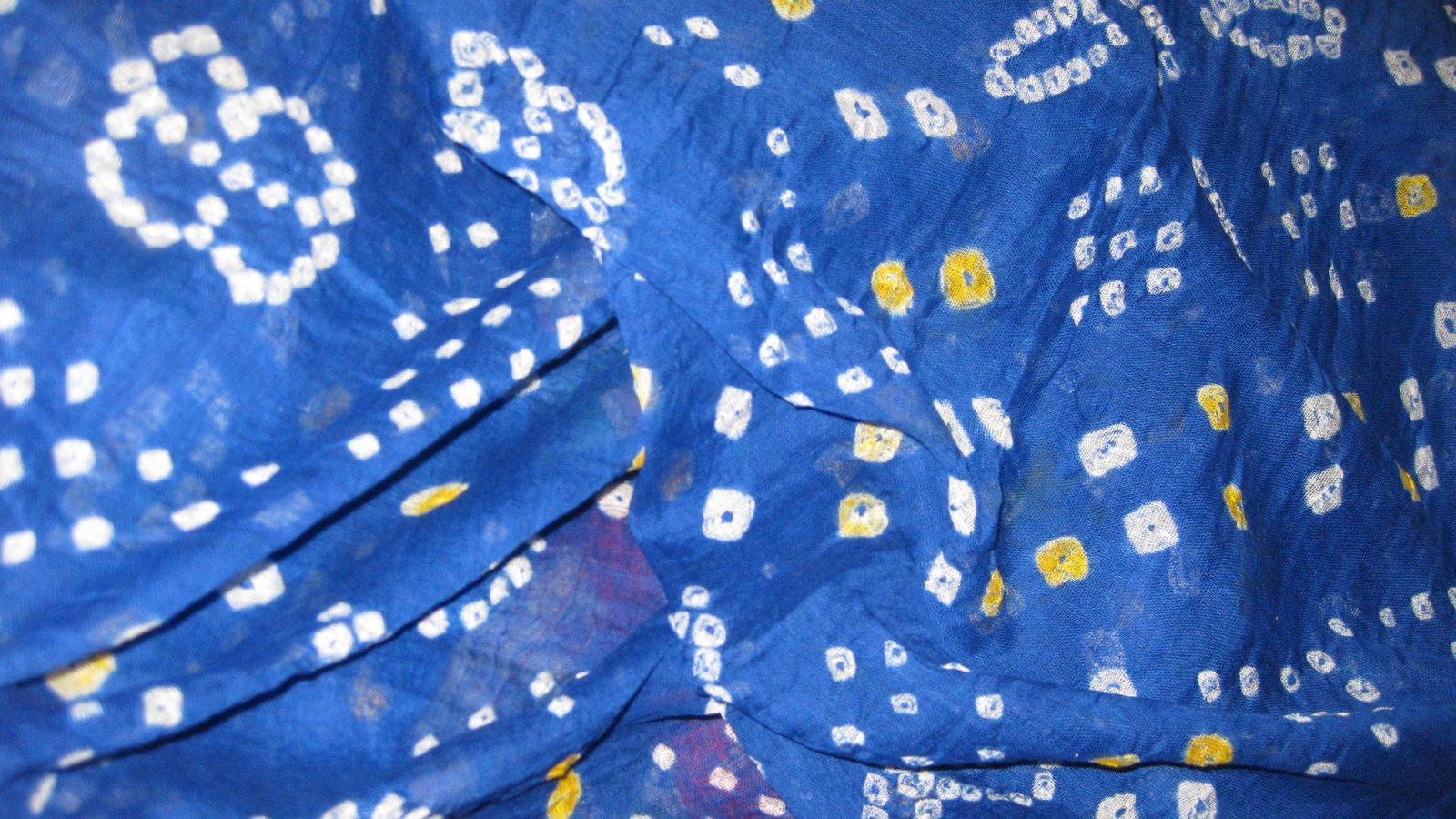
Photo: RubyGoes, CC BY 2.0 (cropped), via Wikimedia Commons

A courtyard in Kutch, Gujarat, in the morning sun.
The pattern is tied in before the colour goes on.
A field of dots
Bandhani is tie-dye, and the name comes from bandh, to tie. Before the cloth goes into the dye, hundreds or thousands of tiny points are pinched up and bound tight with thread. The knots resist the colour. When the cloth is dry and the threads are pulled away, each knot leaves a small ring of undyed cloth, and the whole length becomes a pattern of dots: lines, waves, flowers and peacocks, all made of points.
How it is made
The tying is done mostly by women at home, often with a long fingernail or a small pointed ring to lift the cloth. A fine sari can carry tens of thousands of knots and take weeks. The cloth may be tied, dyed, tied again and dyed again for each colour, from light to dark. Then the lengths are spread in the sun to dry. When you buy it, the cloth still carries the crinkle of the knots.
Why people come for it
Bandhani is worn across Gujarat and Rajasthan at weddings and festivals. In many communities a red bandhani is a bride’s cloth, and at Navratri the dancers wear it. Kutch bandhani carries a Geographical Indication, a legal mark that ties the craft to its region. For visitors from abroad, watching it made is a way into a craft where days of work go in before any colour appears.
Finding the workshops
Bhuj, in Kutch, is the centre. Its old bazaar sells bandhani by the metre and as saris and scarves, and villages around Bhuj and the port town of Mandvi have family workshops. Jamnagar, on the coast, is another centre. Bhuj has an airport and trains from Ahmedabad and Mumbai.
Patterns and their names
Bandhani has a vocabulary of its own. Ekdali is a single dot; chaubandi groups four. Dungarshahi builds the dots into small mountains. Larger designs lay out flowers, dancing figures, elephants and peacocks across a field of tiny points.
Some cloths carry meaning. The gharchola, worn by many Gujarati brides, is red or maroon, divided into a grid with a motif in each square. The panetar is white or cream with a red border, and is often given by the bride’s family. At garba in Navratri, bandhani skirts and dupattas fill the circles.
Who makes it, and the GI tag
In Kutch the craft is carried by the Khatri community, in and around Bhuj. Women usually do the tying at home; the dyeing is often done in the family workshop. Kutch Bandhani was registered as a Geographical Indication in 2024, on an application by a Bhuj association of Khatri bandhani makers.
Jamnagar has its own registration, Jamnagari Bandhani, from 2016. Between them, the two marks tie the name to particular places and makers. For the rest of the region, see the Gujarat guide.
Before you buy
- Real bandhani is crinkled from the knots. A flat, printed copy is not.
- Look at the dots. Hand-tied ones are slightly irregular.
- Finer dots and more colours mean more work and a higher price.
- Wash it cold, by hand, the first time. Some dyes run.
Open a length out in the light. Every dot is a knot someone tied, and then untied.
Plan your visit
| Where to see it made | Khatri family workshops in Bhuj and nearby villages, and in Mandvi; Jamnagar is the other centre. Ask a shop or craft cooperative to arrange a visit, and go in the morning. |
|---|---|
| Where to buy | Bhuj’s old bazaar, by the metre or as saris, dupattas and stoles; Mandvi; Jamnagar’s old market; and government craft emporiums in Ahmedabad. |
| Price guide | No fixed rate. Prices rise with the fineness of the dots, the number of colours and the size of the piece; compare a few shops. |
| How to tell the real thing | Hand-tied bandhani is crinkled, shows the pattern on both sides, and has small, slightly uneven dots, each with a tiny raised peak where a knot was. Printed copies are flat and one-sided. Ask whether the maker is a registered user of the Kutch Bandhani GI. |
| Best season | November to February, when Kutch is cool and the White Rann is dry. |
Questions people ask
Is bandhani the same as tie-dye?
It is a form of tie-dye, but a very fine one. Thousands of tiny points of cloth are tied off with thread before dyeing, so the pattern is made of dots rather than broad swirls.
How long does it take to make a bandhani sari?
A simple piece can be tied in days. A fine sari with many thousands of knots and several colours can take weeks, because the cloth is tied and dyed again for each colour.
What is the difference between bandhani and leheriya?
Both are tie-dye from western India. Bandhani makes patterns of dots from tiny knots; leheriya, mostly from Rajasthan, rolls and ties the cloth to make diagonal waves and stripes.
How should I wash bandhani?
Wash it by hand in cold water, on its own, for the first few washes, since some dyes run. Dry it in the shade, and do not iron out the crinkle.
Read next
Written by Muthu, editor of Aura of India. Sources: GI Registry, India: Kutch Bandhani of Gujarat, GI Registry, India: Jamnagari Bandhani. Last verified: 13 October 2026.
Your turn: Have you watched bandhani being tied in Kutch or Jamnagar? Which village or workshop did you visit?
Comments
Post a Comment
Comments are always welcome, that will help us to motivate ourselves and improve our services. Thanks!!